To learn about all aspects related to Movable Partition Walls, you can consult our comprehensive guide on Movable Partition Walls Hub.
How can a large room provide privacy for separate activities without losing the flexibility of an open layout?
This is a common challenge in conference centers, offices, multipurpose halls, and other buildings where space requirements change regularly. Permanent walls create fixed boundaries, while lightweight dividers may not provide the level of acoustic separation required.
Acoustic operable partition walls offer another approach. Their movable panels allow large interiors to be divided into smaller areas and reopened when needed. With suitable acoustic materials, sealing mechanisms, and an optional integrated access door, these systems can support flexible room layouts while maintaining convenient movement between spaces.
Baker Partition Wall provides customizable operable partition systems designed for different architectural and functional requirements.
The word temporary describes how the room is divided, rather than how long the partition system is installed.
An operable wall can remain installed as part of a building while its panels are opened or closed according to daily requirements.
For example, a conference room may need two separate meeting areas during the morning and one larger presentation space later in the day. Instead of constructing permanent walls, the operator can reposition the movable panels to change the layout.
When closed, the panels form a continuous room division. When opened, they move along the overhead track into a designated stacking area.
This arrangement allows building operators to adjust the space without repeatedly modifying the building's permanent interior structure.
Baker's operable partition system uses individual movable panels supported by an overhead aluminum track.
Each panel travels along the track and can be positioned to form part of the room division. The panels are brought together, and the appropriate sealing and closure mechanisms are engaged.
The main components work together to provide both movement and acoustic separation.
Ceiling-mounted aluminum track
The overhead track supports and guides the movable panels. Depending on the selected configuration, the panels can be arranged to stack at one end or both ends of the opening.
This helps keep the panels organized when the room is used as a larger open space.
Movable acoustic panels
The partition panels form the main physical barrier between adjoining areas.
Their construction and selected finishes influence the appearance, acoustic performance, and practical use of the system.
Telescopic closure mechanism
A telescopic closure helps close the remaining gap between the final partition panel and the adjoining wall.
When used with suitable perimeter seals and panel joints, this mechanism supports a more complete room division and helps limit sound leakage.
Together, these components allow the partition to be moved when required and secured when the space needs to be divided.
An integrated access door is a useful option when people need to move between divided rooms without opening the entire partition.
In a conference facility, for example, staff may need to enter an adjoining meeting area while the main partition remains closed. Opening the complete movable wall would interrupt the room arrangement.
A partition system with an access door provides a more convenient solution.
The door becomes part of the partition configuration, allowing passage while the surrounding wall panels remain in position.
This feature can be useful in:
Conference rooms with separate meeting areas
Hotel function rooms and banquet halls
Training facilities with adjoining teaching spaces
Multipurpose halls requiring controlled movement between sections
Door dimensions, opening direction, hardware, accessibility, and applicable safety requirements should be reviewed during project planning.
The integrated door should also be considered as part of the complete acoustic system because its frame, seals, and connections can affect sound insulation performance.
A movable wall cannot provide effective acoustic separation through panel materials alone.
Sound may also pass through gaps around the partition, connections between panels, and surrounding building elements.
For this reason, acoustic operable partition walls require coordinated panel construction and sealing details.
The telescopic closure mechanism helps complete the wall at its final connection point, while suitable panel joints and perimeter seals help reduce unwanted sound transmission.
An integrated access door must also fit and seal appropriately when acoustic privacy is required.
The resulting performance depends on the selected configuration, installation quality, and surrounding construction.
For projects with specific sound insulation requirements, architects and contractors should request verified acoustic specifications for the proposed partition system rather than assuming that every configuration provides the same level of performance.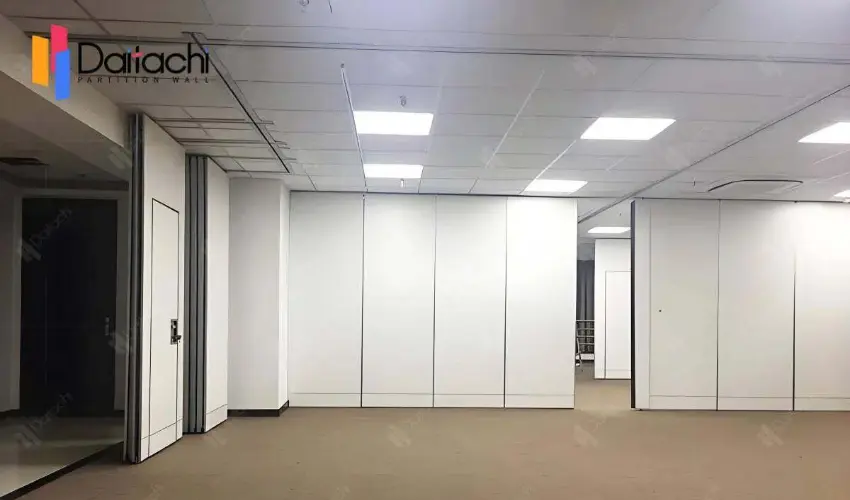
Commercial interiors differ in height, width, architectural layout, and operating requirements.
The original Baker article describes acoustic operable partition wall configurations ranging from 2,000 mm to 16,000 mm in height, with customization options including integrated access doors.
The availability of a particular height or configuration depends on the selected product system and project conditions.
Baker also describes manual and semi-automatic operating options.
With a manual system, users position the panels and operate the relevant locking or sealing mechanisms. A semi-automatic system may automate certain functions, such as seal activation, while retaining manual panel movement.
The appropriate option depends on the partition dimensions, frequency of use, and operational requirements.
For larger openings, the supporting structure, track arrangement, and panel movement should be assessed before confirming the final design.
Acoustic operable partition walls can support a range of interior layouts, but their value depends on how each space is used.
Conference Centers and Offices
Meeting rooms often require both privacy and flexibility.
Movable acoustic walls allow larger rooms to be divided into separate areas for discussions, presentations, or training sessions. An integrated access door can support movement between sections without reopening the main partition.
Hotels and Multipurpose Venues
Hotels and event facilities regularly accommodate gatherings of different sizes.
Operable walls can divide a larger function room into smaller spaces for private events or meetings, then be stored when an open layout is required.
Educational and Training Facilities
Classrooms and training centers may need to support several activities within the same building.
Acoustic movable partitions help create separate teaching areas while allowing the layout to change according to group size and scheduling requirements.
Residential and Shared Interiors
Certain residential and shared-use interiors may also benefit from movable room divisions.
In these settings, panel appearance, ease of operation, and available storage space may be especially important.
The suitability of an acoustic operable wall should be evaluated according to the building's structural conditions, room dimensions, and intended use.
An operable partition system includes moving components that require appropriate inspection and care.
Routine maintenance may involve cleaning the panel surfaces, checking the track and roller assemblies, inspecting seals, and lubricating designated components according to the manufacturer's instructions.
The frequency and scope of maintenance depend on the selected system and how often it is operated.
Access doors and telescopic closure mechanisms should also be checked to ensure they continue to operate correctly.
Proper installation and routine maintenance help support reliable operation, but service life and maintenance costs should not be assumed without considering the specific product and usage conditions.
Before specifying an acoustic operable partition wall, project teams should clarify the following requirements:
| Project consideration | What to confirm |
|---|---|
| Opening dimensions | Required partition height and width |
| Acoustic performance | Target sound insulation and available test documentation |
| Access door | Door location, dimensions, opening direction, and hardware |
| Track configuration | Ceiling support and panel movement route |
| Panel storage | Stacking position and available space |
| Operation | Manual or semi-automatic system |
| Surface finish | Materials and appearance suitable for the interior |
| Maintenance | Access for inspection and routine servicing |
Confirming these details early helps ensure that the proposed partition system matches both the architectural layout and the way the space will be used.
A well-designed operable partition should allow a space to change function without sacrificing practical access or acoustic comfort.
Baker's customizable acoustic operable partition wall systems combine movable panels, overhead tracks, telescopic closure mechanisms, and optional integrated access doors to support different room configurations.
For architects, contractors, and commercial project planners, selecting the right system begins with understanding the opening dimensions, acoustic requirements, access needs, and available panel storage space.
Explore Baker's acoustic operable partition wall solutions or contact the team to discuss a suitable configuration for your project.
Related Articles: How Flexible Partition Systems Are Shaping the Future of Hybrid Workspaces