To learn about all aspects related to Vertical Folding Partition Wall, you can consult our comprehensive guide on Vertical Folding Partition Wall Hub.
For achieving high-quality noise insulation (STC > 50 or RW greater than 50 dB). Vertical-lift folding walls need the integration of the core technology, which includes multi-layer composites, high-density material, air gap barriers and precise seal designs. The analysis below provides thorough explanations of three important categories: the standard definitions as well as technical application and trends in the industry.
STC is a shorthand for the word "sound" means transmission class. It is an American standard which measures - by test in a laboratory--walls' ability to filter out airborne sounds in the range between 125Hz and 4000 Hz. The result is an uni-number number. The fundamental logic of the system is created to replicate human hearing's ability to detect frequency of speech.
STC 30: Conversations that are loud can be heard, however it is impossible to decode the message; STC 50 All conversations are blocked. ideal for hotels with high-end guest rooms. STC 60 speech is totally block, with only very low frequency sounds (e.g. traffic sounds) that could penetrate; perfect for theaters, recording studios, or even the stage.
RW is a shorthand for Weighted Sound Reduction Index. It's an international test that evaluates efficiency of sound insulation within the frequency range 100 Hz to 3150Hz with a single number of ratings, measured in decibels (dB)--after applying a weighting system correction. Its fundamental premise is trying to balance the characteristics of the human ears (which is more sensitive to higher frequencies) and the unique properties of sound insulation in structural components.
RW 40dB is the standard for partitions used in normal meeting rooms. RW 50 dB is a must-have standard for top executive conference rooms and medical centers; RW 60 dB is theater-grade sound insulation which requires special structure.
The main difference lies in the frequency range as well as method of weighting: The top frequency range used for STC tests is set at 4000Hz. It gives more weightage to the high-frequency noise and the higher frequency limitation used for RW tests is 3150Hz. This gives a greater depth of analysis of low-frequency noise. While the numerical results that are derived from these standards are not directly comparable when it comes to situations that demand superior acoustic performance generally, it is required that both standards -- STC greater than 50, and RW > 50 dB--be at the same time.
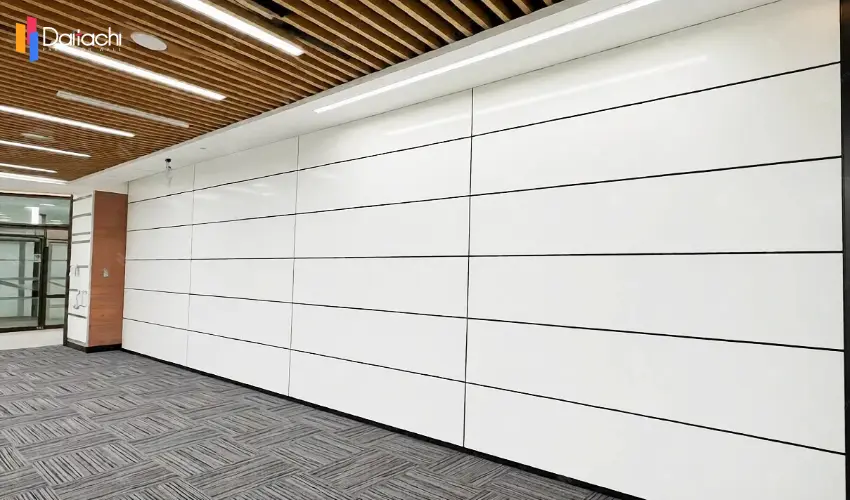
Multi-Layer Composite Structure
A typical construction consists of: "Outer steel plate (impact resistance) + intermediate sound-absorbing cotton (absorbs low-mid-to-high-frequency sound) + The inner layer of damping (suppresses the vibration) + air gap (blocks low-frequency sound) + Decorative panels (aesthetics)." In the case of for instance Baker vertical-lift wall Baker vertical-lift wall makes use of the combination with "double-layer steel plates with high-density wool" that can produce the Sound Transmission Class (STC) of 60 as well as an Weighted Sound Reduction Index (RW) of 58 decibels. It is thus able of blocking speech as well as the bulk of low-frequency sound.
Air Gap Design
The gap in the air creates the "mass-spring-mass" device, which utilizes the air's elasticity to block sound waves of low frequency. For further efficiency it is possible for the air gap to be filled with a gradient-density sound-absorbing cotton, which absorbs the low-frequency sound as well as improve your Weighted Sound Reduction Index (RW).
Precision Sealing System
Vertical Sealing: Utilizes the highest-density sealing strips for magnetic to guarantee a smooth connection between the wall and the floor and ceiling after the wall has been closed.
Horizontal sealing: Uses retractable seal strips for filling the joints between the wall panel, thus eliminating creating the "acoustic bridge" result.
The latest trends: As green building standards place increasingly stricter demands on indoor environments for acoustics Vertical-lift folding walls change away from "single-function" partitions to systems that combine the benefits of "sound insulation and protection against fire and smart control."
Challenges:
Cost: The expense for high-performance sound-insulating walls can be 30% - 50% more expensive than the cost of conventional partitions. Consequently modular design strategies are needed to lower the price per square meters.
Weight: Multi-layer construction adds weight to the wall structure; consequently the capacity to bear load of the track system has to be improved.
Installation High-Performance: The sealing process needs a high degree of uniformity in the wall's construction; as this, the laser positioning system is essential to ensure the highest quality of installation.
Through the integration and application of the mentioned techniques, vertical-lift folding walls can now be used for providing high-quality sound insulation for a broad range of environments, from hotels to health centers, from performance venues to conference locations, and thus serving as an essential solution to flexible division of space within modern-day architectural designs.
Related Articles: Conceptual Analysis of Acoustic Performance Rated at RW62
How Can Vertical Lifting Walls Improve Sound Insulation?