To learn about all aspects related to Movable Partition Wall, you can consult our comprehensive guide on Movable Partition Walls Hub.
When it comes to the movable wall design, the way of installing directly impacts the reliability of the space transformation. This piece compares the technical features of the two main installations from the viewpoint of engineering mechanics, to provide the necessary information for decision-making in projects.
Method for weight distribution: The ground track is used to distribute the load across the area of contact between the track ground and also the crucial turning moment. The top hoisting depends on the dispersion of the hangers, and the overturning force is blocked under the conventional design, so the strength of the inclined rod will need to be increased.
Vertical bearing capacity: The load-bearing capability grows with every increase in depth track. The distance between the hoisting codes at the top reduces and capacity to bear load increases.
Horizontal displacement controls: Double track structure for the ground track is able to regulate the lateral displacement to within millimeters. If the top hoisting uses an arrangement with three points it will cause a displacement higher than what the ground track can handle.
The resistance to pressure under 1.0kPa winds, deformation of the track is millimeter mark; however, the expansion of the hoisting top system is higher under similar circumstances, so wind-resistant clips must be installed.
Vibration transmission suppressor: The shock-absorbing rubber cushion of the ground track causes the rate of attenuation for vibrations up to 75. The top hoisting: The vibration transmittance rate for the structure hanger made of steel is reduced to 50%.
Data from fatigue tests: The track has gone through five hundred closing and opening tests with the wear of the track is to the millimeter and the hoisting hanger at the top attachment has 0.3mm plastic deformation
Maintenance cycle comparability: The track has to be adjusted in track's level each year and the pad that absorbs shock must be changed each 5 years. The top hoisting should be checked to determine the torque of the hanger bolt at least every three years. the structure of steel needs to be treated for rust each 8 years.
Ability to recover in emergency: A single-point malfunction of the track on the ground does not have an impact on the system as it can be fixed in segments when the hoisting spot fails this could cause the regional system to become paralyzed.
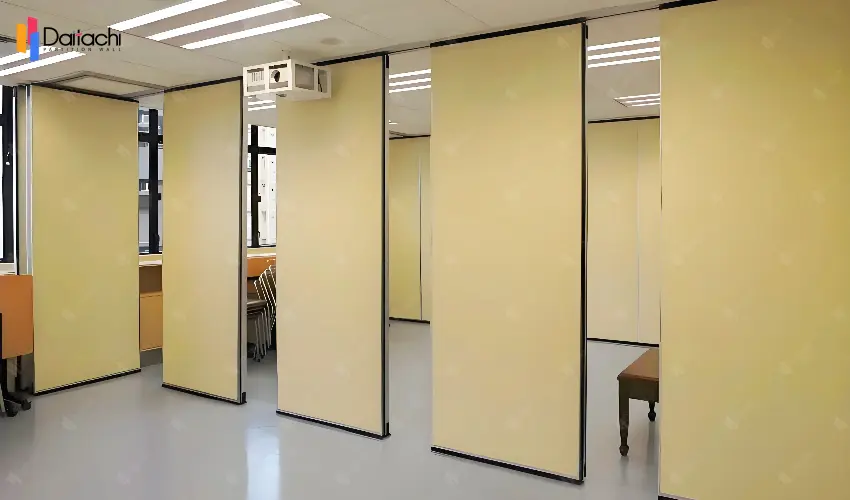
Conditions on the ground: The track on the ground should have an appropriate track to track bulge (usually 30-50mm) and the top hoisting must keep the space clean and have an entirely flat ground
The frequency of usage: Examples of scenarios with high frequency use that require the ground track to be open and shut more than 5 times in a day. The low-frequency display spaces with the top hoisting being removed and reopened 2 times per week.
Renovation difficult: Ground track is ideal for new developments as well as renovations; top hoisting option is suggested in new construction projects (pre-buried hang points are necessary)
Special environments: The ground track is ideal for environments with dust and humidity (excellent sealing) The top hoisting should be located in a safe area (no ground contamination danger)
Latest engineering research shows the benefits that a hybrid system consisting comprising ground track and top guide wheel could achieve that vertical load-bearing can be carried by the ground and the horizontal direction is managed through the top guide wheel. In addition, the resistance to wind improved as well, but also the friction coefficient for closing and opening can be reduced.
Ground tracks provide its basic stability by spreading the weight, while the top hoisting break into the limit of height with its space advantage. In deciding which option to choose, adhere to the rule of "choose ground suitable for high-frequency usage select hoisting that is suitable to achieve ultra-high capacity; and high-strength sealing in humid environments and anti-pollution to ensure a clean environment". If traditional options are hard to decide on and hybrid installation methods redefine the limits of reliability.
Related Articles: Manually Movable Partition Wall Track and Pulley Design
Trackless Design: How Vertical Folding Walls Enable Unobstructed Floor Access (part 1)