To learn about all aspects related to Movable Partition Wall, you can consult our comprehensive guide on Movable Partition Wall Hub.
By adopting a trackless design, vertical-lift folding walls achieve unobstructed floor access, thereby completely resolving the host of issues commonly associated with floor tracks in traditional partition systems—such as obstructed passage, cleaning difficulties, and safety hazards. The core of this innovation lies in the synergistic interplay between the top guiding system, advanced bottom sealing technology, optimized structural mechanics principles, and an intelligent control system. This combination ensures that the wall requires no reliance on floor tracks during the lifting and lowering process, while simultaneously maintaining exceptional structural stability and superior sound insulation performance.
The fundamental principle of the trackless design involves transferring the wall's load-bearing and guiding functions to the overhead structure. This enables the wall to execute vertical lifting via a ceiling-mounted track or suspension system, while simultaneously utilizing bottom sealing technology to compensate for floor irregularities, thereby ensuring airtightness and stability when the wall is in the closed position. The technical logic can be broken down into the following key components:
Overhead Load-Bearing and Guiding
Through the overhead track system, the entire weight of the wall is borne by the ceiling structure or overhead beams. The floor requires only a minimal clearance gap to accommodate the compression space for the sealing strips; consequently, there is no need to install any tracks on the floor surface.
Dynamic Bottom Sealing
The bottom of the wall is fitted with high-density, retractable sealing strips. When the wall descends into position, these strips automatically fill the gap between the wall and the floor, creating an effective acoustic seal and acting as a dust barrier, all while preventing any friction between the bottom of the wall and the floor surface.
Structural Mechanical Balance
By optimizing the distribution of the wall's self-weight and employing a dynamic balancing system, the design ensures that the wall maintains perfect vertical alignment throughout the entire lifting and lowering process, thereby effectively preventing any wobbling or jamming caused by shifts in the center of gravity.
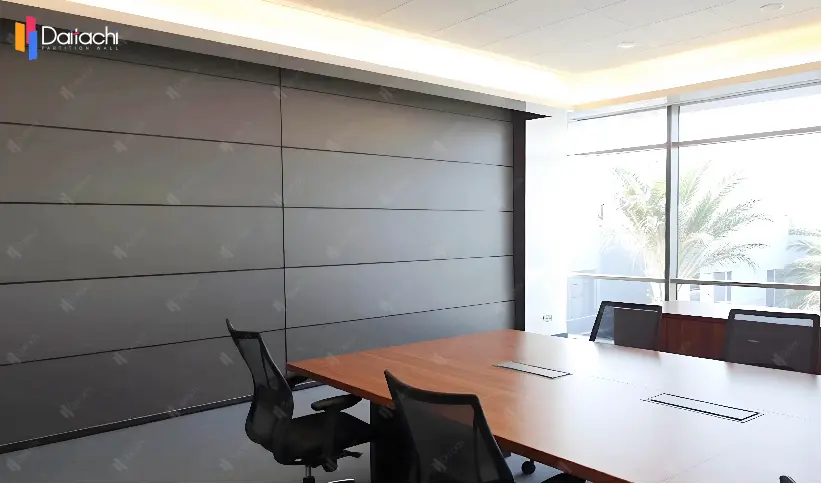
High-End Hotels and Banquet Halls
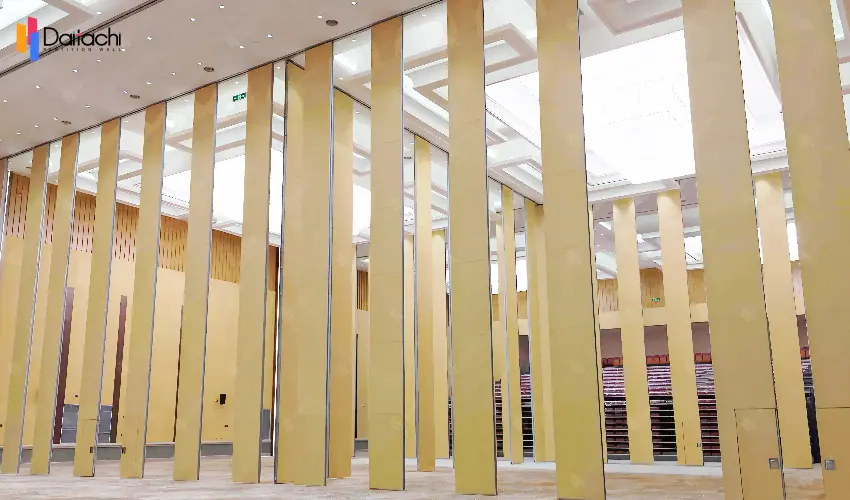
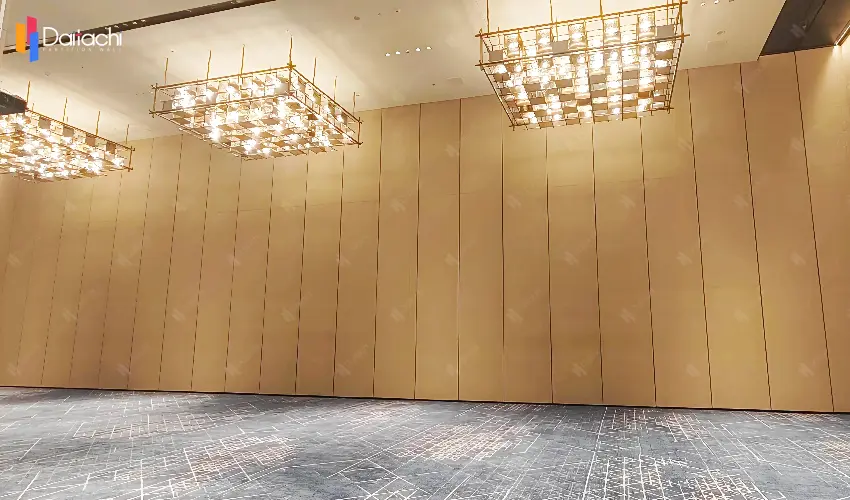
Within hotel interiors, trackless vertical-lift partitions enable the rapid separation of banquet halls from lounge areas. The completely flush floor design greatly facilitates the movement and transport of stage equipment and props.
Healthcare Facilities and Laboratories
In hospital operating rooms, trackless partition systems can be utilized to segregate sterile zones from contaminated areas. When paired with bottom sealing strips, these systems achieve an airtight level of isolation, thereby meeting the most stringent infection control requirements.
Commercial Complexes and Exhibition Centers
In shopping malls, trackless folding partitions are frequently employed to delineate the boundaries between atriums and retail zones. Thanks to their rapid deployment capabilities and barrier-free floor design, these systems ensure convenient and unimpeded pedestrian flow for shoppers.
Accessibility Features
The trackless design fully complies with architectural accessibility standards, completely eliminating the obstructions that floor tracks might otherwise pose to wheelchair users or individuals with mobility impairments, thereby significantly enhancing the overall inclusivity of the space.
Related Articles: the Versatility of Vertical Lift Folding Walls in Creating Trackless Designs
Trackless Design: How Vertical-Lift Folding Walls Enable Unobstructed Floor Access (part 2)