To learn about all aspects related to Vertical Folding Partition Wall, you can consult our comprehensive guide on Vertical Folding Partition Wall Hub.
As a core tool for space partitioning, vertical lifting walls are evolving from single-function devices to intelligent, ecological, and scenario-based solutions. Combining technological iteration, market demand, and sustainable development concepts, future designs will exhibit the following trends:
IoT and AI Empowerment: Vertical lifting walls will embed sensors, cameras, and AI algorithms to achieve environmental perception and autonomous decision-making. For example, by monitoring indoor light, temperature, and noise in real time, they can automatically adjust light transmittance, activate sound insulation mode, or link with the air conditioning system, creating "breathing smart walls."
Voice/Gesture Control: Users can operate the lifting wall via voice commands or gestures, eliminating the need for physical contact and improving hygiene, safety, and ease of use. For example, in medical settings, healthcare workers can quickly partition spaces via voice to avoid cross-infection.
Predictive Maintenance: Based on big data analysis, the system can provide early warnings of mechanical failures or material wear, reducing downtime risks and maintenance costs. For example, functions such as motor life monitoring and track wear warnings will become standard features.
Low-carbon Material Application: Utilizing environmentally friendly materials such as recyclable aluminum alloys and bio-based panels reduces the carbon footprint. For example, bamboo fiber composite panels replace traditional wood, meeting strength requirements while maintaining renewability.
Energy Self-sufficiency System: Integrating solar thin films or kinetic energy recovery devices to power the wall's drive system. For instance, the mechanical energy generated during lifting can be converted into electricity and stored in built-in batteries, achieving energy recycling.
Vertical Greening Integration: Embedding detachable plant modules on the wall surface creates a "growing green wall." An automatic drip irrigation system maintains plant growth, beautifying the space and improving air quality, meeting urban ecological restoration needs.
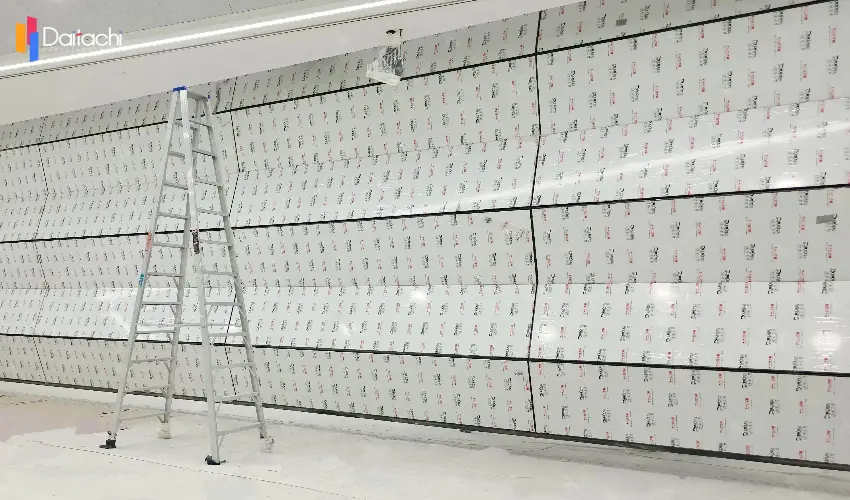
Modular Combination: The wall will adopt a standardized modular design, supporting rapid assembly and functional expansion. For example, users can choose different functional modules such as sound insulation, light transmission, and fire resistance to flexibly combine them into meeting, leisure, or temporary office spaces.
Immersive Experience: Combining AR/VR technology, dynamic visual content can be projected onto the wall surface, creating immersive scenes. For example, in commercial showrooms, the wall can switch product display backgrounds in real time, enhancing interactivity and appeal.
Accessibility Design: Designed for the elderly and disabled, the wall will integrate voice prompts, low-speed operation, and anti-pinch functions to ensure safe and convenient use. This design will be prioritized in settings such as hospitals and nursing homes.
Ultra-narrow bezels and hidden tracks: By optimizing the mechanical structure, the bezel width can be reduced after the wall folds, and the tracks can be hidden in the ceiling or floor, achieving a "virtually invisible" visual effect. For example, magnetic levitation technology can be used to replace traditional tracks, further reducing space occupation.
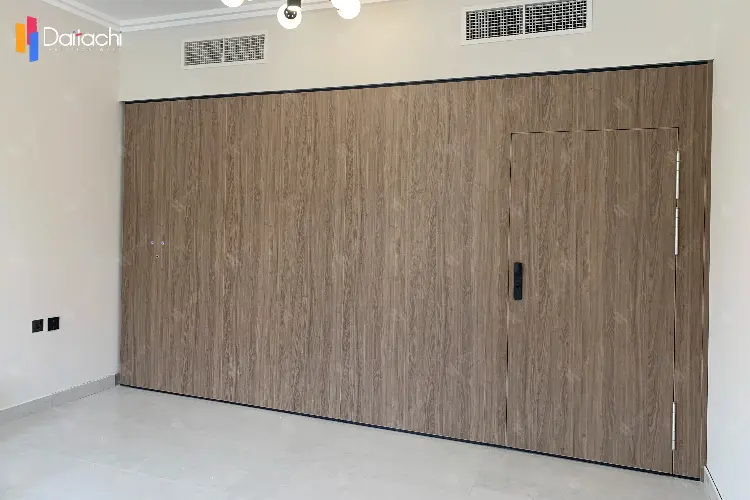
Customizable Materials and Colors: A variety of finishes are available, including wood grain, stone grain, and brushed metal, supporting RGB lighting systems to seamlessly integrate the wall with the architectural style. For example, in high-end residences, the wall can simulate marble textures, blending seamlessly with the interior decoration.
Dynamic Lighting Effects: LED light strips are embedded within the wall, and program-controlled light and shadow transitions or pattern projections enhance the sense of spatial depth. For example, in art galleries, the wall can become a dynamic lighting installation, increasing the exhibition's appeal.
Multiple Braking Systems: Equipped with electromagnetic braking, hydraulic locking, and mechanical limit switches, a triple safety mechanism ensures rapid stopping in emergencies, preventing the risk of falls. For example, in high-rise buildings, the wall must pass rigorous safety certifications to meet extreme environmental requirements such as earthquake resistance and wind resistance.
Data Encryption and Privacy Protection: Environmental data collected by the smart wall (such as temperature and humidity) will be processed through edge computing, avoiding uploads to the cloud and reducing the risk of privacy leaks. For example, blockchain technology is used to store user operation records, ensuring data immutability.
Fire and Explosion Proof Design: For industrial scenarios, the wall will use fire-resistant panels and explosion-proof glass to prevent the spread of fire or the impact of explosions. For example, in chemical workshops, the wall must have a fire resistance limit of more than one hour to ensure personnel safety.
The future vertical lifting walls will transcend their traditional role as partitioning tools, becoming a core hub of smart spaces, a green interface for ecological buildings, and a creative carrier for personalized scenarios. Through technological integration and scenario innovation, we hope that in the future they will not only efficiently utilize space but also redefine the interaction between people and buildings, and between people and nature, providing key solutions for sustainable urban development.
Related Articles: Vertical Folding Lift-Up Walls: The Ideal Choice for Future Spaces