To learn about all aspects related to [Movable Partition Wall], you can consult our comprehensive guide on Movable Partition Walls Hub.
In modern architecture and space design, movable partitions are increasingly favored by office buildings, hotels, conference centers, and exhibition halls as an important solution for flexibly dividing space. To meet different needs, the market mainly offers three types of movable partitions: manual, semi-automatic, and fully automatic. This article will provide a comprehensive comparison of these three types from the perspectives of function, ease of operation, cost, and applicable scenarios, offering a reference for your partition selection.
Features and Advantages
Manual movable partitions are the most traditional type, relying on manual pushing, pulling, or folding to divide space. Their main advantages include:
Low cost: Lower purchase and maintenance costs compared to semi-automatic and fully automatic systems;
Simple structure: Easy to install and replace parts;
Flexible adjustment: Suitable for small meeting rooms or temporary space division.
Limitations
Manual operation: The amount of pushing and pulling is large when the partitions are heavy or numerous;
Relatively low efficiency: Time-consuming operation when frequently moved or used in large spaces;
Limited functionality: Cannot achieve intelligent control or remote operation.
Suitable Scenarios: Manual partitions are suitable for small meeting rooms, training rooms, temporary exhibition areas, etc., and are especially suitable for projects with low partition usage frequency and limited budgets.
Features and Advantages
Semi-automatic movable partitions combine the advantages of manual and mechanical assistance, typically using a track system or lightweight drive device to reduce operating resistance. Advantages include:
Easy Operation: Less force is required to push or pull the partition, suitable for frequent space adjustments;
Flexible Installation: Track length and number of partitions can be customized according to space size;
High Cost-Effectiveness: Between manual and fully automatic partitions, with a moderate cost.
Limitations
Partial Reliance on Manual Operation: Still requires some manual operation;
Limited Functionality: Cannot achieve full automation or remote control;
High Requirements for Tracks: Uneven track installation may affect the user experience.
Suitable Scenarios: Semi-automatic partitions are suitable for medium-sized office spaces, conference centers, and multi-functional halls, especially suitable for projects with certain requirements for ease of operation but limited budgets.
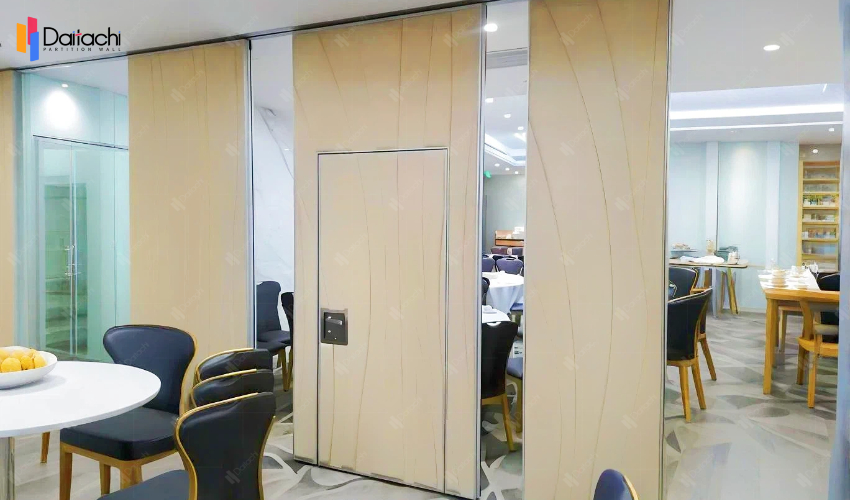
Features and Advantages
Fully automatic movable partitions utilize an electric drive system, allowing for space division via buttons, remote control, or an intelligent control platform. Key advantages include:
Easy Operation: Easily achieves automatic movement of large-area partitions;
Intelligent Control: Can be integrated with building intelligence systems for timed or remote control;
Improved Space Efficiency: Quickly adjusts spatial layout, increasing flexibility;
High-End Experience: Suitable for high-end commercial spaces or venues requiring frequent adjustments.
Limitations
Higher Cost: Procurement, installation, and maintenance costs are higher than manual and semi-automatic partitions;
High Maintenance Requirements: Motors and control systems require regular maintenance;
Technology Dependence: Requires high-performance power and control systems.
Applicable Scenarios: Fully automatic partitions are suitable for high-frequency use scenarios such as large conference centers, five-star hotel banquet halls, and exhibition halls, as well as projects seeking a high-end, intelligent spatial experience.
When choosing a suitable type of movable partition, consider the following principles:
Budget Considerations: Manual partitions are suitable for low budgets, semi-automatic is moderately sized, and fully automatic is expensive.
Usage Frequency: For frequent space adjustments, semi-automatic or fully automatic partitions are recommended.
Space Size and Weight: Large-area, heavy partitions are more suitable for fully automatic systems.
Smart Technology Needs: Projects requiring remote control, timed operation, or integration with smart building systems should choose fully automatic partitions.
Manual, semi-automatic, and fully automatic movable partitions each have their advantages and disadvantages. Manual partitions are economical and practical, semi-automatic partitions balance ease of operation and cost, and fully automatic partitions are suitable for high-end, intelligent spaces. Choosing the appropriate type based on space characteristics, budget, and usage needs will maximize the value and functionality of the movable partition.
Related Articles: Movable Partition Wall Series: in-depth Analysis of Models 65, 85, and 105