To learn about all aspects related to Vertical Folding Partition Wall, you can consult our comprehensive guide on Vertical Folding Partition Wall Hub.
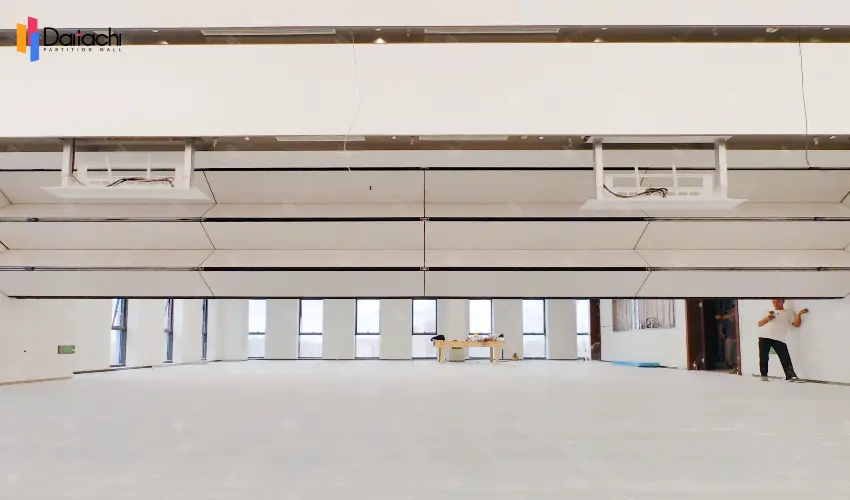
The motor in a vertical lifting partition wall is the core driving component that enables the entire system's automatic lifting function. Its role is not only crucial for ease of operation but also directly impacts the system's stability, safety, and service life. Below is a detailed explanation of the motor's main functions in a vertical lifting partition wall:
The motor converts electrical energy into mechanical energy, driving the transmission system (such as steel cables, chains, or timing belts) to smoothly raise or lower the wall modules along the track. This eliminates the need for manual pushing or pulling, allowing the space to be opened or closed in seconds, significantly improving efficiency.
Modern vertical lifting partition walls are usually equipped with intelligent control systems. The motor, in conjunction with encoders or limit switches, can achieve precise positioning, allowing the wall to stop at any preset height (such as a semi-open state for ventilation or visual transparency); or soft start/soft stop, avoiding shocks and vibrations during starting and stopping, protecting the structure and enhancing user experience; and adjusting the lifting speed according to scene requirements, balancing efficiency and quiet operation.
High-quality motor systems integrate multiple safety protection mechanisms, such as:
Automatic obstacle detection and reversal: When the wall encounters an obstacle during lowering, the motor immediately stops and reverses direction, preventing pinching or equipment damage;
Overload protection: Automatic power cut-off in case of abnormal current, preventing motor burnout;
Emergency power failure handling: Some systems support manual release devices, allowing the wall to be safely lowered even during a power outage.
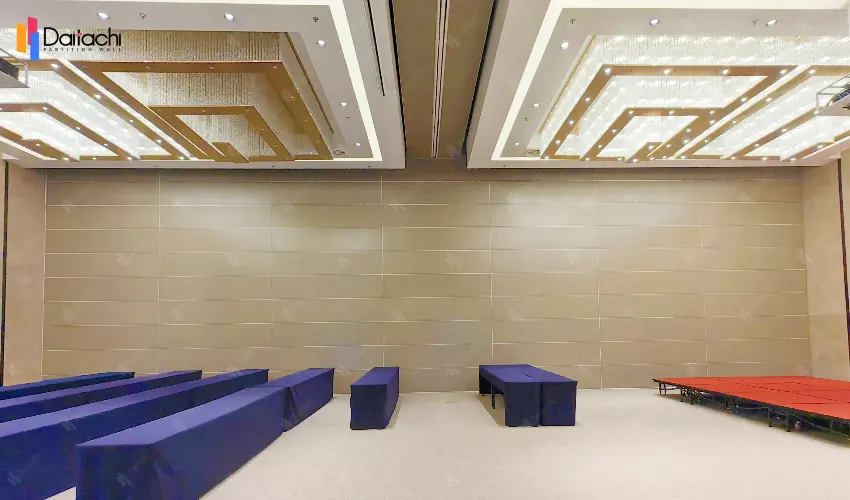
As an execution terminal, the motor can be integrated into building automation systems, central control panels, mobile apps, or voice assistants. It can also achieve remote control, collaborating with lighting, air conditioning, access control, and other equipment, as well as providing usage records and fault self-diagnosis.
The motors we use are industrial-grade silent geared motors with high torque and low speed characteristics, suitable for frequent starting and stopping; a high IP protection rating allows them to adapt to different environments (such as humidity in banquet halls or dust in exhibition halls). The vertical lifting folding wall has a lifespan of tens of thousands of lifting cycles and low maintenance costs.
Although the motor is "hidden" within the ceiling, it is crucial for the automation, intelligence, and safety of the vertical lifting partition wall. Choosing lifting walls equipped with high-quality motors and advanced control systems will not only enhance the user experience of the space but also ensure long-term stable operation.
Related Articles: Vertical Folding Lifting Wall: Analysis of Silent and Precise Control Technology
Vertical Lifting Walls: Unveiling the Secrets and Core Advantages of Single-Motor Drive Technology