To learn about all aspects related to Vertical Folding Partition Wall, you can consult our comprehensive guide on Vertical Folding Partition Wall Hub.
In the field of flexible space partitioning in architecture, vertical folding lifting walls are gradually becoming the preferred solution in modern architectural design due to their efficiency, safety, and flexibility. Unlike traditional multi-motor drive systems, vertical lifting walls require only one motor to achieve the lifting and lowering movement of the entire wall. This design, seemingly counterintuitive, actually embodies sophisticated mechanical engineering wisdom. This article will delve into the core value of single-motor drive technology from three dimensions: working principle, structural advantages, and application scenarios.
The single-motor drive system of a vertical lifting wall essentially converts mechanical energy into vertical motion through a chain, gear, or traction system. Its core principle is analogous to the traction system of an elevator:
Power Transmission Chain: The motor reduces speed and increases torque through a reducer, driving the active sprocket or traction wheel to rotate. The chain or traction rope is fixedly connected to the lifting platform, forming a closed-loop transmission system. When the motor rotates, the cyclic movement of the chain is directly converted into the vertical displacement of the platform.
Balancing and Compensation Mechanism: The system has a built-in counterweight device, which balances the weight of the wall through the principle of leverage, significantly reducing the motor load.
Guidance and Safety System: High-precision guide rails ensure the stable operation of the wall in the vertical direction, preventing deviation or swaying; the brake automatically locks when the power is cut off to prevent falling; limit switches precisely control the travel range to avoid overtravel risks.
1. Simplified Structure, Reduced Failure Rate
Multi-motor systems require synchronous control of multiple drive units, and the failure of any one motor can lead to overall paralysis. Single-motor drive, however, uses a single power source for unified control, reducing mechanical connection points and electrical control nodes, resulting in a failure rate reduction of more than 60%.
2. 20% Increase in Space Utilization
Multi-motor systems require installation space for each motor, while single-motor drive concentrates the power unit in the top or bottom machine compartment, freeing up valuable space on both sides of the wall, thus reducing the pressure on space to a certain extent.
3. Millimeter-level Synchronization Accuracy
Through high-precision encoders and a closed-loop control system, single-motor drive achieves millimeter-level synchronization for wall lifting and lowering, avoiding wall distortion or jamming caused by response delays in multi-motor drive systems.
4. 50% Reduction in Maintenance Costs
The single-motor system has 40% fewer parts, and the maintenance cycle is twice as long as that of multi-motor systems.
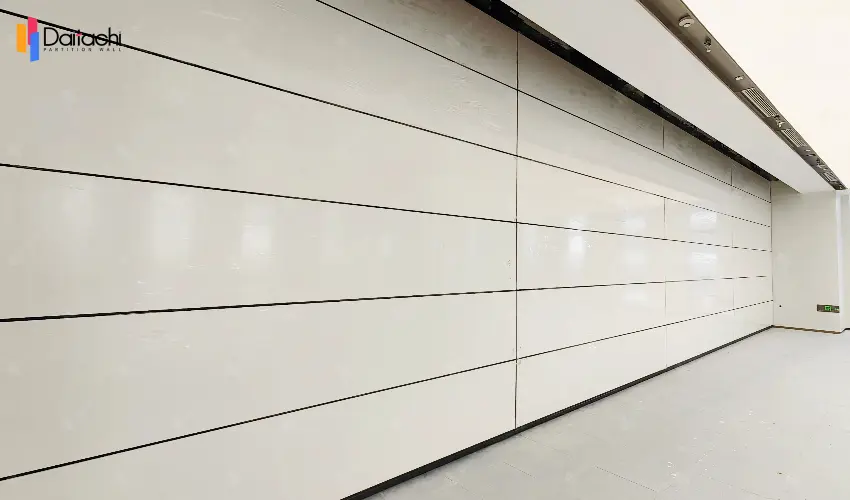
Commercial Spaces: In shopping mall atriums, single-motor lifting walls can quickly separate dining areas from activity areas, with a single lift/lower cycle taking only 1 minute, meeting the needs of high-frequency use.
Exhibition Halls: In large exhibition halls, a 30-meter-long lifting wall driven by a single motor can support 10-ton exhibition equipment, and the synchronization accuracy ensures the safety of exhibits.
Hotel Banquet Halls: Single-motor drive enables silent wall lifting and lowering, with noise controlled below 45 decibels, avoiding disruption to the banquet atmosphere.
Industrial Plants: In clean workshops, the sealed design of the single-motor lifting wall maintains a positive pressure environment, preventing dust intrusion.
The single-motor drive technology for vertical lifting walls, based on the "less is more" design philosophy, achieves a perfect balance of structure, energy efficiency, space, and cost. It is not only an innovative breakthrough in mechanical engineering but also a vivid interpretation of the "efficient, safe, and sustainable" concept in modern architecture.
Related Article: the Role of the Motor in Vertical Lifting Partition Walls
What Is the Internal Structure of a Vertical Lifting Wall?