To learn about all aspects related to Vertical Folding Partition Wall, you can consult our comprehensive guide on Vertical Folding Partition Wall Hub.
Modern architecture is moving toward flexible, adaptable, and intelligent environments.
As businesses and public spaces continue to change, traditional fixed walls often cannot meet the demand for multifunctional layouts. This has increased the importance of vertical lifting wall systems, which allow spaces to transform efficiently while maintaining architectural quality.
By combining advanced technology, smart control, and flexible design concepts, vertical lifting walls are becoming an important solution for future space management.
One of the key development trends of vertical lifting wall systems is the integration of intelligent technology.
Modern systems are no longer limited to simple mechanical movement. Advanced control technologies improve operational efficiency, safety, and user experience.
Intelligent features may include:
Automated lifting and lowering
Smart control interfaces
Safety detection systems
Precise movement control
These technologies allow users to quickly transform spaces according to different requirements.
For example, a conference room can become a larger collaboration area, while an open space can be divided into private working zones when needed.
The combination of automation and architectural design allows vertical lifting walls to provide smoother and more convenient space transformation.
The future of architecture is shifting from fixed layouts toward adaptable spaces.
Vertical lifting wall systems support this trend by allowing one area to serve multiple purposes without major structural changes.
In modern offices, they can help create:
Flexible meeting rooms
Collaborative work areas
Training spaces
Private discussion zones
In commercial environments, they are widely applied in:
Exhibition halls
Hotels
Conference centers
Cultural venues
By enabling quick spatial transformation, vertical lifting walls improve space utilization and allow buildings to respond more effectively to changing needs.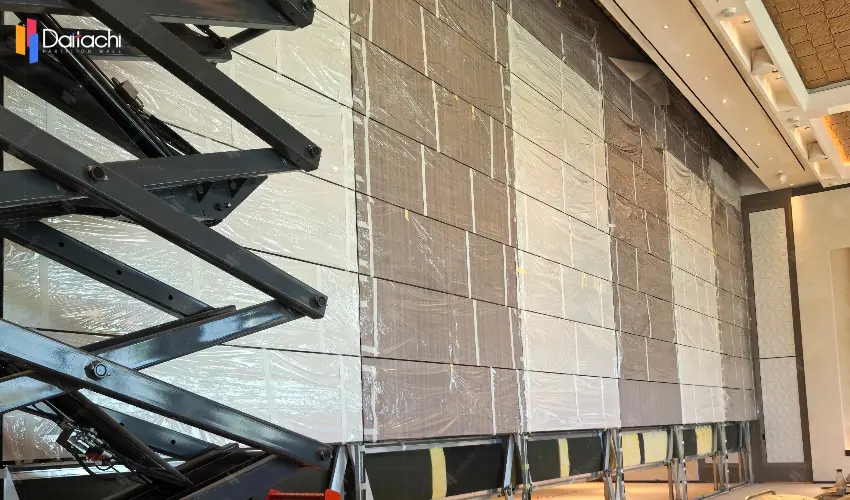
Sustainability has become a major consideration in contemporary architectural design.
Compared with traditional fixed construction methods, flexible partition systems can reduce unnecessary renovation and support more efficient use of existing spaces.
Vertical lifting wall systems contribute to sustainable design through:
Reusable structural components
Reduced construction waste
Long service life
Improved space efficiency
By allowing spaces to adapt without permanent reconstruction, these systems support the development of more sustainable and resource-efficient buildings.
Future vertical lifting wall systems will continue to evolve through deeper integration between engineering and design.
Beyond mechanical performance, modern solutions focus on:
Better acoustic performance
Seamless architectural integration
Improved user experience
More intelligent operation
The goal is not only to divide spaces but to create environments that can naturally adapt to human activities.
As buildings become smarter and more flexible, vertical lifting walls will play an increasingly important role in shaping future architectural spaces.
The future of vertical lifting wall systems is defined by intelligence, flexibility, and adaptability.
Through smart control technologies, sustainable design principles, and efficient space management, these systems provide a practical solution for modern architectural challenges.
From offices and commercial buildings to exhibition spaces and public facilities, vertical lifting walls enable buildings to evolve with changing requirements.
Flexible architecture is no longer only about creating more space — it is about making every space work smarter.
What are vertical lifting wall systems used for?
Vertical lifting wall systems are used to create flexible layouts in offices, conference rooms, exhibition halls, hotels, and other multifunctional spaces.
How do intelligent technologies improve vertical lifting walls?
Smart technologies improve operation through automated control, safety monitoring, and more precise movement management.
Are vertical lifting wall systems suitable for sustainable buildings?
Yes. Their flexible and reusable design can reduce unnecessary renovation and support sustainable space management.
What is the future trend of vertical lifting wall technology?
Future developments will focus on intelligent operation, improved efficiency, acoustic performance, and better integration with modern architecture.
Related Project: Four Season Hotel, Saudi Arabia