To learn about all aspects related to Vertical Folding Partition Wall, you can consult our comprehensive guide on Vertical Folding Partition Wall Hub.
Vertical wall lift systems, thanks to their benefits of flexibility spatial division and better use of space, are the preferred choice for offices, exhibition halls, hotels and many other locations. In the wrong way, the installation process can result in difficulties like problems with wall movement, excess sound, poor sealing as well as safety risks. Being a professional supplier of premium vertical lift wall systems. Baker is drawing from decades of experience in installation is able to provide five common issues and the solutions they provide to minimize risk and ensure long-term steady operation of your device.
Typical Problems:
A lack of even or adequate load-bearing capacity of the floor which causes the floor to tilt or shake during lifting. Failure to prepare tracks or fixing points onto ceiling or wall which can cause structural damage when forced installation is required Failure to take into account the layout of network lines and power which can lead to a chaotic installation afterward.
Solutions:
The preliminary survey: Prior to installing take a measurement of the floor's flatness and ensure that the total error is less than 5mm. Then, confirm the ceiling's load bearing capacity.
Structural Reinforcement for old buildings, or for lightweight partition walls, strengthen the track's location prior to installation;
Pre-embedded Wiring Plan: Lay out both control and power wiring concurrently in conjunction with the remodel to avoid future trenching, and possibly destruction to the wall.
Typical Problems:
Extreme vertical or horizontal deviance of the tracks causing walls to become jammed or make a noise of friction when lifting. Large gaps in track joints which can cause wall shake or derailment. Leaky fixing screws, or failure to install washers that are anti-loosening, leading to track loosening following prolonged use.
Solutions:
Accurate Leveling: Make use of the laser level to measure the tracks. It has the horizontal error being 1mm/m;
Seamless Splicing: Install specific connectors for track joints to guarantee an effortless transition
Reinforced Fixing: Apply the expansion bolts to fix tracks at every 50cm. You can also use spring washers with anti-loosening properties.
Expert Advice: Following the installation of your track, you should run at minimum three testing runs to verify good operation prior to installing the wall.
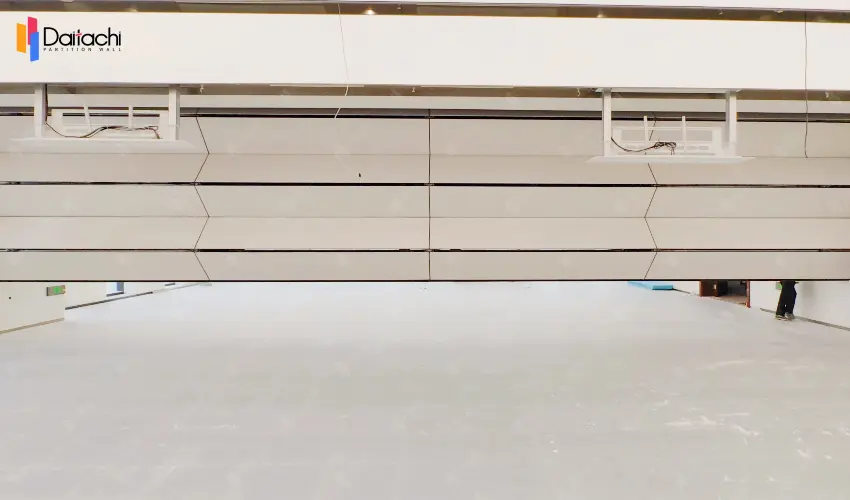
The most common problems are:
A wrong splicing sequence for the module which results in an irregular compression of the sealing strips, leading to the sound and air to leak; improperly aligned latches or an absence of limit devices that cause an uneven wall lift or ignoring the protection of surfaces, leading to scratches in the wall's finish after installation.
Solutions:
Sequential assembly: Ensure that you strictly follow your "bottom-up, inside-out" splicing in order to ensure uniform compressing of sealing strips
The calibration of latches: Make use of special instruments to alter the location of latches within modules within an error range of <=0.5mm;
Protection for the surface: Wrap it with the protective film prior to installation in order to stop tools from touching directly the finished.
Support for data: Properly constructed walls will improve the sealing efficiency by 30 percent, and also achieve sound insulation at 50 decibels or more.
The most common problems are:
Interference between low-voltage and high-voltage lines can cause signals interfering or short circuits; inability to put in protection against leakage, creating an electric shock risk or motor wiring that is loose, creating sudden shutdowns, or strange sounds during operation.
Solutions:
Separate wiring: Keep the distance between the low and high voltage wires, and utilize steel conduits to shield;
Safety protection: The primary control box has to be fitted with a leakage safety switch. Additionally, the grounding resistance should meet specific standards.
Professional wiring: Make use of the torque wrench to tighten the terminals of your motor for the safety of electrical wiring in the wall.
Standards for the industry: Electrical installations should be in compliance with specifications of power distribution designs as well as wiring diagrams that should be saved for future use as a reference.
Common problems:
Inability to perform full load testing that results in wall deformation when bearing weight is applied; not conducting tests for noise, leading to an excessive amount of operating noise (>55dB) and failure to properly train employees, which can lead in equipment damages caused by inadequate use.
Solutions:
Tests that are thorough: Perform at least 10 lifting tests that do not require load to ensure smooth operation. test at least three full-load wall bearing tests to test the structural integrity; make sure that the noise test is quiet.
Training for operators Training for operators: Supply the user with an operational manual in writing and also demonstrate the maintenance aspects on site (e.g. Lubrication cycle or troubleshooting).
Installing an retractable folding wall is an engineering task. From surveying the site and track fixing, to electrical wiring and acceptance tests each step has to strictly conform to the specifications of the manufacturer. Selecting a qualified team for installation (such such as the "free survey + standardized installation + lifetime maintenance" service) will significantly decrease chances of unexpected malfunctions and ensure that the space partitioning system you choose to use is really "trouble-free, highly efficient, and long-lasting."
Related Articles: Vertical Lifting Folding Walls: Facilitate Rapid Installation and Renovation Projects
From Installation to Maintenance: A Lifecycle Guide to Vertical Folding Wall Panels (Part 1)