To learn about all aspects related to Vertical Folding Partition Wall, you can consult our comprehensive guide on Vertical Folding Partition Wall Hub.
A high-quality vertical folding lift wall is not only a flexible component for your space, but also a long-term investment. To ensure its stable, safe, and efficient operation throughout its entire lifecycle, every step, from initial planning and installation to daily use and maintenance, is crucial. This guide systematically analyzes the key aspects of the entire lifecycle of vertical lift walls.
Successful installation begins with meticulous planning.
1. Site Survey and Design Confirmation
Dimension Verification: Accurately measure the opening width and height, ground flatness, ceiling height, and load-bearing structure of the installation location. Ensure that the actual dimensions are completely consistent with the design drawings.
Environmental Assessment: Check the power supply location in the installation area, identify any obstructions such as frames or wiring, and assess the ground's load-bearing capacity.
Solution Confirmation: Finalize the wall specifications (dimensions, finish), drive method, control mode, and operating path with our engineers.
2. Basic Preparation
Structural Requirements: The ceiling and floor of the installation area must have sufficient structural strength to withstand the self-weight of the walls, counterweights, and dynamic loads during operation. Reinforced concrete or steel structures are typically required.
Power Supply: A dedicated power line meeting the power requirements must be pre-installed at a designated location, and properly grounded.
Space Clearance: Ensure the installation area and operating path are unobstructed and provide ample working space.
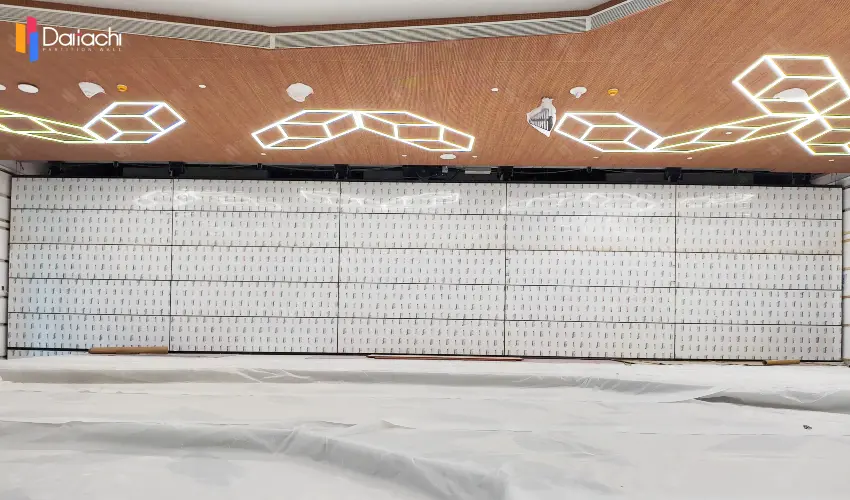
The installation process determines the initial performance and lifespan of the product.
1. Main Frame and Track Installation
Using professional tools such as laser levels, the top load-bearing structure (I-beams/high-strength alloy steel beams) and high-strength tracks are installed with extremely high precision. The levelness and verticality of the tracks are the physical basis for "smooth operation."
High-specification fasteners must be used throughout the installation process to ensure all connection points are secure and reliable.
2. Wall Assembly and Suspension
Assemble the wall panel modules on a flat surface, ensuring tight connections and a flat panel surface.
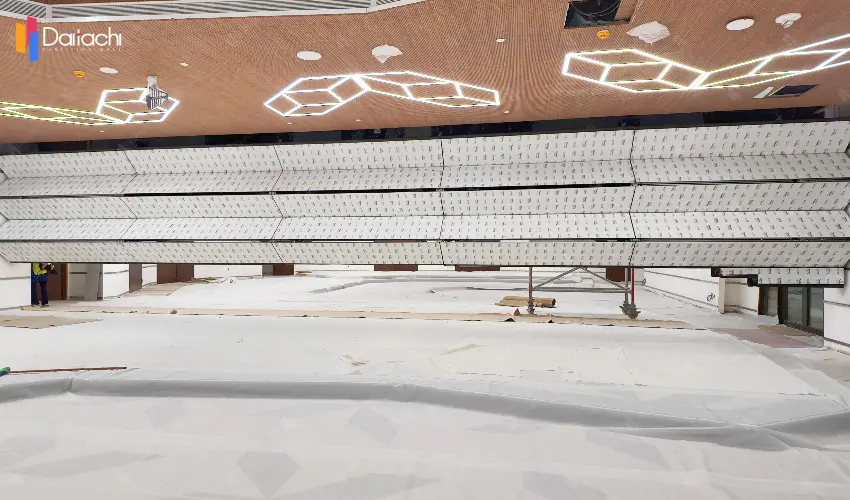
The assembled wall panels are safely hoisted using specialized lifting equipment and precisely suspended onto the track pulley system. This process requires close teamwork to avoid collisions.
3. Drive System and Counterweight Integration
Install drive components such as the silent motor, synchronous drive shaft/wire rope, etc.
Core Step: Dynamic Balance Adjustment. Based on the actual weight of the wall panels, precisely add or remove counterweights within the counterweight chamber to ensure near-balance in any position. This is crucial for achieving labor-saving and low-noise operation.
4. Comprehensive Commissioning and Functional Testing
Electrical Connection: Connect the control system and conduct safety tests (insulation, grounding, etc.).
Operational Commissioning: Test the smoothness of the entire lifting process, adjust synchronization, and ensure complete consistency on both sides.
Set upper and lower limits and test the deceleration and stopping effect of the buffer device.
Repeatedly test safety sensing functions (e.g., barometric pressure sensors, infrared sensors, etc.).
Sealing and Finishing: Install high-density sealing strips around the perimeter to ensure sound insulation and dust prevention, and perform final finishing.
Related Articles: Signs That Your Vertical Lifting Wall Needs Maintenance
From Installation to Maintenance: A Lifecycle Guide to Vertical Folding Wall Panels (Part 2)