To learn about all aspects related to Movable Partition Walls , you can consult our comprehensive guide on Movable Partition Walls Hub.
Conference centres across the United Arab Emirates need interior spaces that can accommodate different events, from corporate meetings and training sessions to seminars, exhibitions, and private functions. Fixed walls can limit how these venues are used, particularly when room sizes need to change throughout the day.
Acoustic movable walls offer a practical alternative. These horizontal sliding partition systems allow large rooms to be divided into smaller spaces or reopened when a larger venue is required. When appropriately specified and installed, they can also help reduce sound transmission between adjacent rooms.
For conference centres in Dubai, Abu Dhabi, and other commercial locations across the UAE, choosing the right movable partition system involves balancing acoustic requirements, operating convenience, architectural design, and long-term maintenance.
Conference venues often host multiple activities simultaneously. One area may accommodate a business presentation while an adjacent room is used for training or private discussions.
Without suitable acoustic separation, noise from one activity may disturb another. Permanent walls can provide separation but offer limited flexibility when room configurations need to change.
Acoustic movable partition walls help address both requirements. Individual panels slide along an overhead track and connect to form a partition when separation is needed. When the wall is opened, the panels move into a designated storage position, allowing adjacent areas to function as a larger space.
This makes operable walls a practical option for conference centres, hotels, banquet venues, and other multi-purpose commercial interiors.
For a broader overview of available systems, explore BakerWall's guide to different types of movable partition walls.
Sound insulation is an important consideration when selecting movable walls for conference rooms. Effective acoustic separation can help reduce speech transmission between adjacent spaces and support more comfortable meeting environments.
BakerWall's original product information identifies different partition series for different acoustic requirements:
85 Series: Offers reported sound insulation performance of up to 52 dB Rw.
100 Series: Offer reported performance of up to 54 dB Rw, according to the original product description.
These figures represent stated maximum performance, not a guarantee that every installation will achieve the same result. Actual performance depends on the selected configuration, tested assembly, installation quality, and surrounding construction.
Acoustic seals, panel joints, and perimeter connections also influence sound leakage. For this reason, project teams should review the applicable test documentation and confirm that the selected system meets the venue's requirements.
For more information, read BakerWall's article on sound insulation and measurement for movable partitions.
One of the main advantages of acoustic movable walls is the ability to change room layouts without rebuilding permanent internal walls.
In a conference centre, a large hall can be divided into separate meeting rooms for simultaneous sessions. When a larger event is scheduled, the partition can be opened to reconnect the areas.
This flexibility can support:
Corporate meetings and business presentations.
Training sessions and workshops.
Seminars and conference breakout rooms.
Hotel functions and private events.
Multi-purpose halls with changing occupancy requirements.
The appropriate layout depends on the venue's floor plan, circulation routes, room capacity, and panel storage arrangement. These factors should be considered during the design stage to ensure that the system works efficiently in daily operation.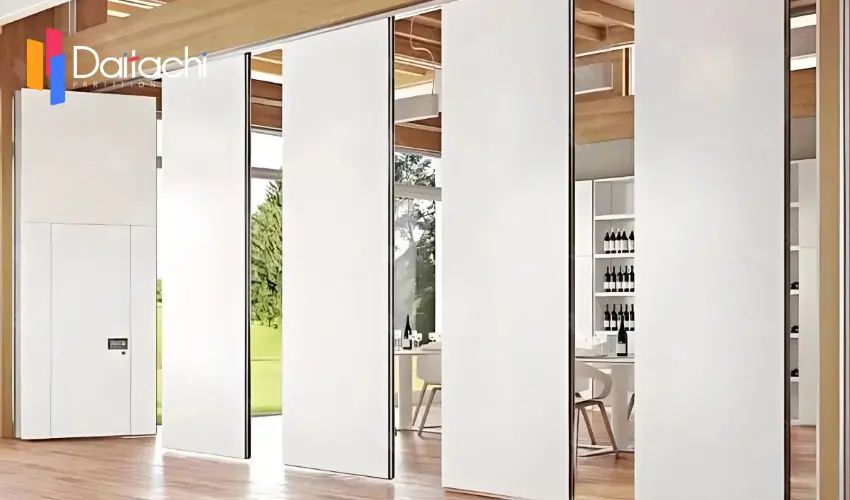
Conference centres need functional partition systems that also complement their interior design.
BakerWall's original article describes finish options including fabric, wood veneer, laminate, and customised surfaces. These finishes allow designers to coordinate the partition panels with wall treatments, furniture, lighting, and the wider architectural concept.
A consistent finish can help the partition blend into the surrounding interior when closed, rather than appearing as a separate technical installation.
For venues with frequent room changes, the design team should also consider panel storage locations, access routes, and how the partition will look in both open and closed configurations.
Every conference centre has different requirements. Before specifying acoustic movable walls, architects, contractors, and facility managers should assess several practical factors.
Acoustic targets: Identify the required sound insulation level and verify it against the manufacturer's test documentation.
Room dimensions: Confirm the opening width, panel arrangement, ceiling height, and available storage space.
Operating method: Consider how frequently the partition will be moved and whether manual or semi-automatic operation is more suitable.
Building coordination: Review the overhead supporting structure, track installation, and potential conflicts with lighting and mechanical services.
Maintenance access: Ensure that the track, rollers, seals, and operating components can be inspected and serviced appropriately.
Early coordination with the partition supplier helps align product selection with the architectural drawings and operational requirements of the venue.
Acoustic movable walls provide conference centres in the UAE with a flexible way to manage room layouts while addressing the need for sound separation. By combining adaptable configurations, suitable acoustic performance, and coordinated finishes, these systems can support a wide range of commercial events.
The best solution depends on the venue's room dimensions, acoustic targets, operating frequency, and installation conditions. Reviewing verified performance data and coordinating technical requirements early helps project teams make informed decisions.