To learn about all aspects related to Vertical Folding Partition Wall , you can consult our comprehensive guide on Vertical Folding Partition Wall Hub.
Modular vertically folding walls significantly reduce maintenance costs, primarily due to their standardized design, rapid assembly and disassembly, partial replacement capabilities, and the potential for intelligent management. The following analysis explores these factors from three dimensions: technical principles, maintenance processes, and cost comparisons:
Unified Specifications and Interfaces: Modular partitions use standardized dimensions and universal interfaces, making all components interchangeable.
Cost Advantages: Eliminating the need for customized parts for different areas reduces spare parts inventory by over 50% and lowers procurement costs.
Pre-Integrated Functional Modules: Partitions can integrate power, lighting, and other systems. Each module is individually packaged and uses standardized functional interfaces.
Easy Maintenance: When a function fails, only the corresponding module needs to be replaced; there is no need to disassemble the entire wall, significantly reducing repair time.
Non-Destructive Disassembly Technology: Modules use a mortise and tenon structure, connected by snap-fit fasteners and slide rails, eliminating the need for welding or adhesives. Disassembly does not damage adjacent components.
Simplified Tools: Disassembly and assembly can be completed with only basic tools such as wrenches and suction cups, requiring no specialized equipment or highly skilled workers.
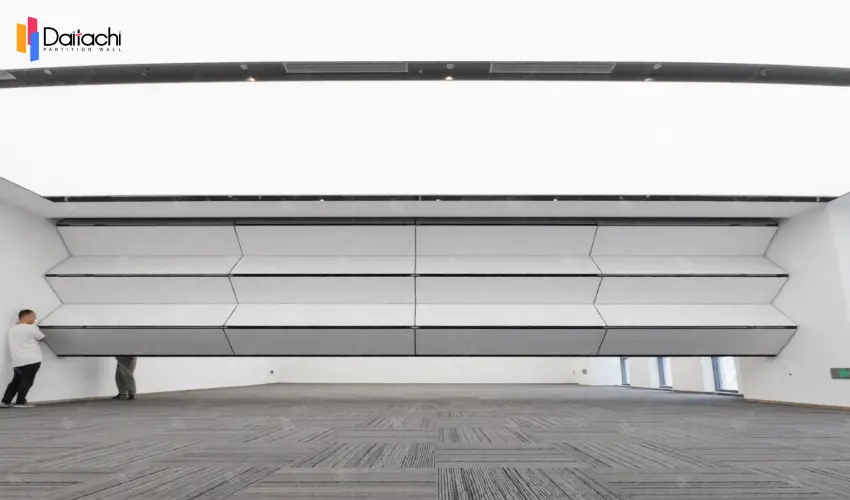
Single Module Damage Does Not Affect the Whole: When a module (such as a panel or hinge) is scratched, deformed, or malfunctions, only that module needs to be replaced, without disassembling the entire partition.
Cost Comparison: Traditional partitions require complete replacement for partial damage, while modular vertical lift wall systems can be replaced based on specific materials.
Material Recyclability: Modular partitions typically use recyclable materials such as aluminum alloys and plastics. Discarded modules can be disassembled and recycled, with a residual value of 30%-50%, further reducing the total lifecycle cost.
Modular partitions, through standardization, rapid disassembly and assembly, partial replacement, and intelligent management, transform the operation and maintenance model from "passive maintenance" to "proactive prevention," significantly reducing spare parts costs, labor costs, and downtime losses. Industry statistics show that modular partitions significantly reduce the overall lifecycle maintenance cost of projects, making them particularly suitable for commercial spaces with frequently changing layouts and scenarios with high reliability requirements.
Related Articles: Are Vertical Lifting Walls Modular Products?
How Modular Lift Walls Help Organizers "Recoup" Renovation Costs?
Vertical Lifting Wall Components: Materials and Functional Description