To learn about all aspects related to Movable Partition Wall, you can consult our comprehensive guide on Movable Partition Walls Hub.
Cultural and educational venues often struggle to balance spatial flexibility and interior aesthetic consistency.
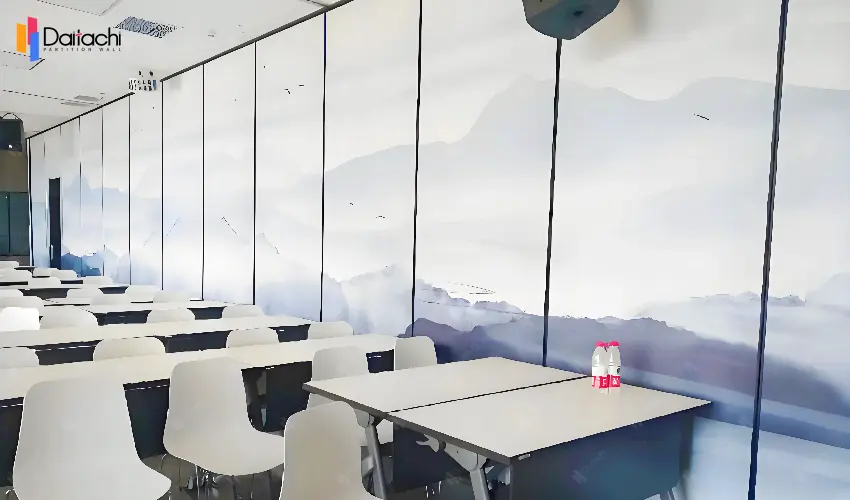
This project centres on a set of manually operated movable partition walls installed inside a community art centre. Custom printed ink‑wash landscape patterns turn functional operable room dividers into integrated decorative features, while preserving rapid layout switching for workshops, exhibitions and public lectures. The following walkthrough covers site constraints, custom finish design, daily‑use performance and practical takeaways for similar cultural‑space fit‑outs.
The art centre previously relied on one single large open hall for all scheduled activities. The space had to alternate between large collective art lectures, small‑group sketching sessions, independent studio practice and temporary public display events.
Building permanent dry‑wall partitions would permanently fragment the floor area and eliminate future layout flexibility. Standard plain movable partition panels solved the dividing problem but felt visually plain, clashing with the venue’s artistic, culturally focused identity.
Two core goals were defined at project kickoff. First, the manual operable partition must deliver smooth, reliable top‑hung sliding operation without relying on electrical power. Second, panel surfaces needed to carry ink‑wash landscape visual language, while meeting public‑space fire‑safety, low‑emission and acoustic requirements.
Instead of hand‑painting panels on site, high‑definition ink‑wash artwork was printed directly onto panel decorative facings during factory production. Misty mountain ridges, layered tree clusters and distant birds are arranged to flow seamlessly across adjacent panels when the partition is fully closed.
When the partition is folded and stacked against the wall, the printed panels tuck neatly into a designated storage zone. The full panoramic scene remains intact and can be presented again whenever the wall is fully deployed.
This industrial printing approach avoids the high labour cost and fragility of on‑site hand painting. Low‑saturation monochrome ink tones create a calm, artistic backdrop without distracting from artworks or on‑site teaching activities. For specifiers exploring decorative surface options for manual operable partitions, balancing aesthetic finish and daily‑use durability for manually movable partition walls offers useful material‑selection guidance.
Beyond visual customisation, the partition system was engineered to withstand frequent daily reconfiguration.
The system uses a concealed ceiling track and rolling trolley assembly, with no floor rail obstructing the ground. Venue staff can push individual panels to adjust zone boundaries without any power supply.
During multi‑class afternoons, the large hall can be split into three independent small teaching rooms in minutes. When hosting public exhibitions, all panels slide fully back to the storage end, restoring the full open‑floor space. This rapid reconfiguration directly lifts venue utilisation rate across varying booking types.
All panel substrates and decorative inks meet low‑VOC emission standards for public cultural buildings. There is no strong lingering chemical odour after installation, allowing the space to be reopened quickly.
Panel substrates also achieve the required fire‑retardant grade for publicly accessible assembly spaces. Printed surfaces carry a scratch‑resistant top coat, built to withstand accidental contact and frequent pedestrian traffic typical of art activity zones. To learn how common wear issues appear in high‑traffic movable partition deployments, understanding frequent operational faults and preventive measures for daily‑used operable walls helps facility teams plan routine inspections.
Each panel contains layered sound‑absorbing infill, paired with compression sealing strips along panel edges and the bottom closure. These seals block narrow gaps that would otherwise carry sound between adjacent zones.
Demonstration narration, group discussion noise and visitor conversation stay contained within each divided room. Multiple parallel activities can run simultaneously without cross‑zone acoustic disturbance.
After handover, the art centre gained both flexible zoning and a distinctive visual feature for its interior.
The ink‑wash operable partition no longer reads as purely functional hardware. It acts as a large‑scale decorative backdrop that aligns with the centre’s cultural positioning. Administrators can reconfigure the hall layout in minutes according to daily scheduling, with no demolition or secondary decoration required.
From an operations perspective, manual movable partitions carry relatively low long‑term maintenance burden. The stain‑resistant printed surface wipes clean easily, matching the busy, high‑throughput rhythm of a community art centre. For project owners weighing long‑term value against upfront cost, calculating lifecycle operating and maintenance costs for commercial operable partition installations supports more accurate venue budget planning.
This art‑centre case demonstrates a practical design approach for public cultural venues. Movable partition walls are not limited to basic space separation. Through custom decorative finishes, operable partitions can become an integrated part of the venue’s interior design narrative.
When specifying decorative manual partitions for galleries, training centres and community cultural halls, visual design should never override core performance indicators. Fire safety, low‑emission materials, acoustic sealing and wear resistance must all be evaluated side‑by‑side with aesthetic goals. Balancing these priorities is what delivers a successful, long‑lasting finished result.