To learn about all aspects related to Movable Partition Wall, you can consult our comprehensive guide on Movable Partition Walls Hub.
Understanding the cost structure is essential to balancing budget and functionality when choosing movable partition walls. Here are the key factors that affect pricing:
Core frame: Aluminum alloy (6000 series) costs 30-50% more than carbon steel, but has excellent corrosion resistance and lighter weight.
Panel substrate: High-density fiberboard (HDF) is medium-cost and suitable for standard environments; phenolic resin impregnated boards are 20% more expensive and used in high humidity areas; aluminum-plastic composites are a good choice for chemical corrosion resistance/fire protection.
Surface treatment: Fluorocarbon spraying costs 2-3 times more than standard powder coating, but can maintain color for more than 15 years.
Track system: Track design with hidden suspension mechanism costs 40% more than single track system, but slides more smoothly.
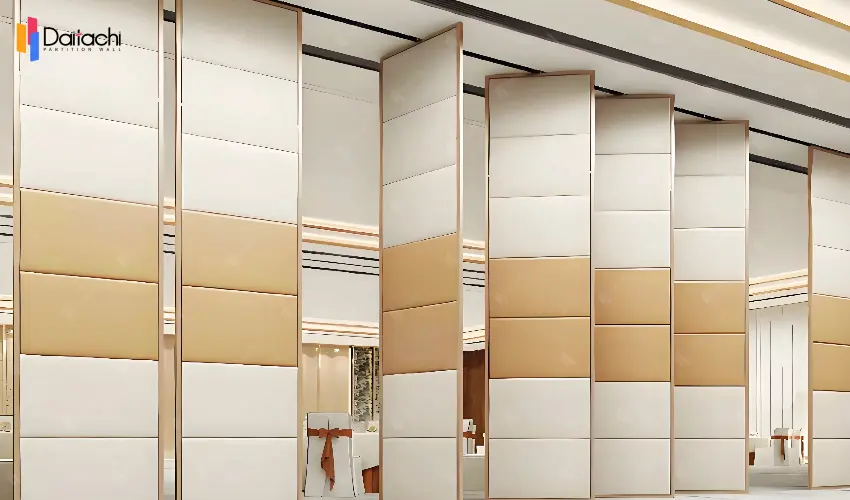
Folding mechanism: Accordion panels with patented optimized angles (e.g., 350 mm thick after folding) require advanced R&D and increase costs by 15-25%.
Sealing technology: Multi-layer sealing materials cost 30% more, but the sound insulation effect reaches STC54dB.
Size adjustment: Non-standard height or curved design requires customization, and the unit price increases by about one-fold.
Small batch production: Custom orders of less than 10 pieces cost 20-30% more due to inefficient setup.
Compliance standards: International certification requires the use of environmentally friendly materials (e.g., VOC-free paint), which increases costs by 10-15%.
Labor complexity: Panels over 10 meters require certified installers, and labor costs increase by 40%.
Maintenance contracts: Annual grease replacement (salt spray resistant type) and seal inspections increase life cycle costs.
Cost-effective strategy guide: Longevity in coastal areas: marine-grade aluminum + graphene coating; Rapid spatial reconfiguration: modular folding system; Acoustic performance: double-layer panels with sound-absorbing cotton; Aesthetic consistency: custom wood veneer + invisible hinges.
The cheapest options often have hidden costs (such as rust repair costs). Investing in corrosion-resistant materials (6000 series aluminum) and modular design, although the upfront cost is 20-30% higher, reduces the life cycle cost by 50%.
Related Articles: Movable Partition Wall Series: in-depth Analysis of Models 65, 85, and 105
Learn About Movable Partition Walls Without Breaking the Bank
Fixed Walls VS Partition Walls: Which Is the Most Cost-effective Solution for Space Renovation?
Manually Movable Partition Walls: Flexible Space, Divided at Will