To learn about all aspects related to Vertical Folding Partition Wall, you can consult our comprehensive guide on Vertical Folding Partition Wall Hub.
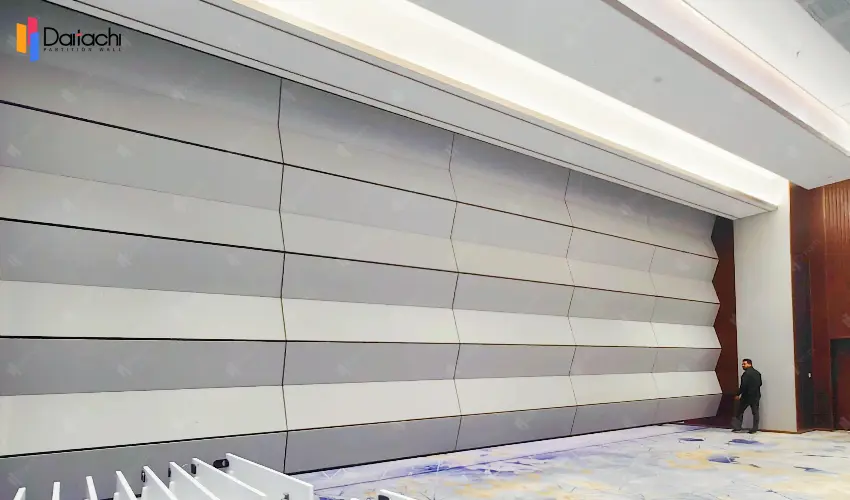
With the twin pressures of rapid urbanization as well as limited available space, vertical retractable lifting walls have evolved from conventional techniques for partitioning space into essential parts of the next buildings which are integrating the concepts of intelligence, sustainability and context. This article will examine the development of vertical walls in three angles: technological innovation and application scenario development as well as ecological cooperation.
1. Material Revolution: The Art of Balancing Lightweight and High Strength
Metal frames are traditional, but while robust, they are heavy and therefore not suitable for use in buildings with high rises. New generation vertical walls made from aerospace-grade aluminum alloy as well as carbon fiber composites, which reduces the square-meter weight by 40 percent, while also guaranteeing load-bearing capability. With the honeycomb structure the wall can achieve an STC60 sound insulation rating. A single layer wall that weighs only 35kg/m2 which makes it ideal for building structures with high-end construction.
2. Drive System: From Mechanical Transmission to Energy Recovery
Older hydraulic drive systems came with dangers of leakage of oil as well as excessive energy use. The latest generation of equipment have completely changed towards servo motors. Energy recovery equipment converts the potential energy generated by the lifting process into electric energy. This can save 15% of the energy consumed for each lifting cycle. Even more noteworthy is the breakthrough in magnetic levitation technology--achieving frictionless lifting, reducing operating noise to below 35 decibels, approaching library environment standards.
3. Intelligent Control: From Button Operation to Spatial Perception
The extensive combination in Internet of Things technology gives vertical walls of lifting "spatial awareness." We are currently working on an application that utilizes integrated lidar as well as AI algorithms that automatically detect individuals' density as well as activity trajectory and dynamically adjust the division scheme. As an example, in an environment for conference rooms the moment increases in the number of participants is observed that wall will automatically increase to accommodate more people. Once the event is over the wall retracts, and then hides behind the ceiling.
1. Commercial Spaces: A Catalyst for Dynamic Rental Models
Shopping malls with large sizes can benefit from clever vertical lifting walls that create atriums into exhibition booths that are temporary and have different dimensions. Malls can carry out spaces that are reconfigured from 100㎡ up to 500㎡ in less than an hour, according to the needs of the company, thereby making space useable by up to 30 percent. The "Space-as-a-Service" model is reshaping the assessment of value in commercial real property.
2. Healthcare Sector: Intelligent Barriers for Infection Control
In the prevention of infectious diseases and control vertical lifting walls offer distinct benefits. The antibacterial-coated walls that are used in high-end hospitals are able to be transformed from a standard partition into a negative pressure isolation area in just thirty minutes. When combined with UV disinfection units as well as airtight sealing create a secure system that drastically decreases the risk of cross-infection.
1. Energy Internet: Walls Become Power Generation Units
The latest advances in photovoltaic film technology allow vertically lifting walls to create power. Researchers are working to integrate perovskite-based photovoltaic layering on the wall that ensures transparency, while also achieving an appropriate amount of electricity production per square millimeter. If the wall retracts the panels that are photovoltaic automatically fold into a power generation array that will provide green power for the structure.
2. The Management of Carbon Footprint: Green Revolution From the Product to the Supply Chain
Vertical wall construction has set up a full-lifecycle carbon monitoring system. From extraction of raw materials all the way to recycling, the carbon emissions data at each step is stored. The products are certified using a standard procedure, requiring that they emit acceptable carbon emissions throughout their life span. The recycling program allows 95% of the components for new walls making a closed-loop economic system.
The 2030 date for vertical lifting walls will totally alter human relations with the space around them:
Spatial Density: Area of effective building grows by 40% while the rate of land use doubles.
Response speed: The period from the command until spatial reconfiguration has been reduced to only a few seconds.
Ecological value: A year-long reduction in carbon for each building is 50 tonnes which is which is equivalent to planting 2800 trees.
Economic Model Space: Leasing market is larger than hundreds of billions and gives an opportunity to the profession that is "space operator."
With this new spatial technology, vertical wall partitions that retract are no longer just mechanical components, transforming into an interconnected neural network that connects the world of physical and digital. By integrating continuously with the latest technology, we are experiencing the emergence of a greener, more intelligent and more humane age of space.
Related Articles: Vertical Folding Lift-Up Walls: The Ideal Choice for Future Spaces
Vertical Lifting Partition Walls: Ushering in a New Era of Energy-Efficient Space Management