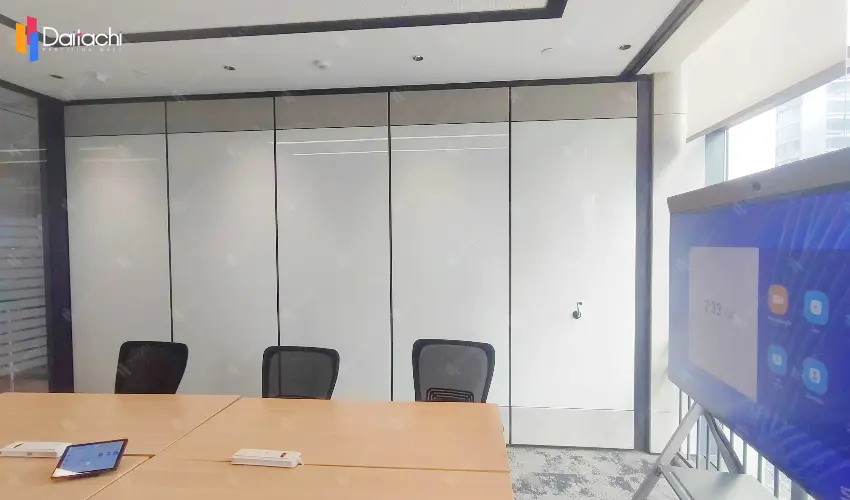
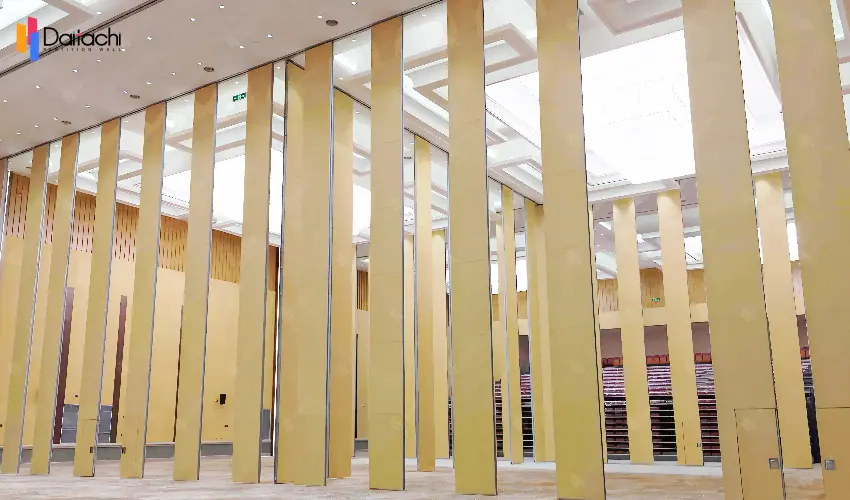
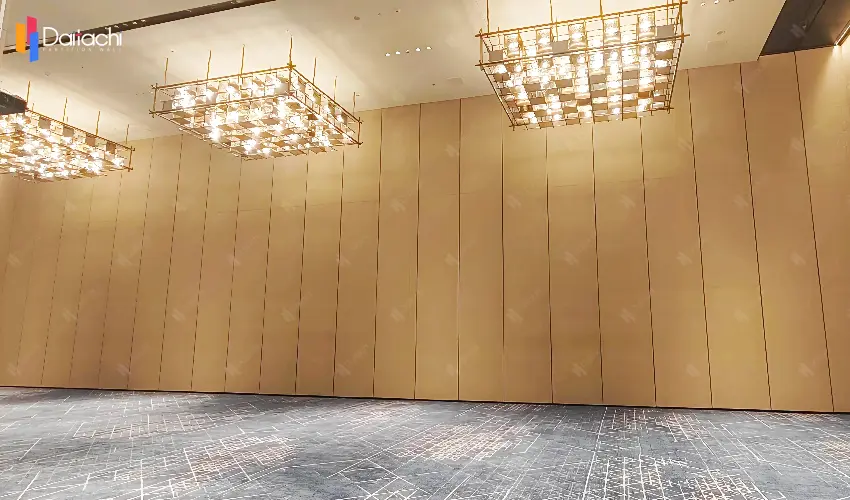
To learn about all aspects related to Movable Partition Wall, you can consult our comprehensive guide on Movable Partition Walls Hub.
Veneer
Definition: The term refers to a fibreboard, plywood, or particleboard substrate that is covered with the 0.2-1mm thickness of engineered or natural veneers, bonded together by the pressure of high temperatures and with a very strong.
Processing: A number of processes are needed, such as choosing the veneer, patterning as well as substrate treatment such as veneering and hot pressing, in order to keep the wood's natural texture as well as color.
Highlights: It blends the aesthetic appeal of natural wood and the strength of synthetic boards. It has a beautiful texture on the surface and robust aesthetic characteristics.
Density Board
Definition: A piece of board that is composed of wood, or any other plant fibers that are prepared by fiber processing using synthetic resin, as well as heat and pressure.
Processing: The fibers and adhesives are put together using the pressure of high temperatures and at high temperatures which results in a smooth, flat surface that lacks any grain of natural.
Characteristics: Unified construction and simple processing however it's not as resistant to moisture, and is susceptible to deformation and swelling when it absorbs water.
Water Resistance: Veneer's resistance is dependent on the material (e.g. multi-layer board offers better resistance to moisture); MDF has poor resistance to moisture, and has an expansion rate of water absorption greater than 45%.
Nail Holding Strength: Veneer is stronger (when it is made of multi-layer boards (or Particle board); MDF is weaker and easily loses its grip after secondary assembly.
Environment Performance: Veneer depends on the veneer's adhesive as well as its treatment. MDF makes use of a large amount of glue and is generally E0 grade, which makes less eco-friendly as solid wood.
Ability to Work: Veneer can be cut and formed, however it is important to take care of the joints of veneer. MDF is a very delicate material. It's easy to handle intricate designs (such as European-style carved designs).
Stability: Veneer's base material is the basis for the stability (multi-layer base material offers an extremely strong resistance to deformation). MDF is vulnerable to humidity and carries a probability of bending under prolonged loads.
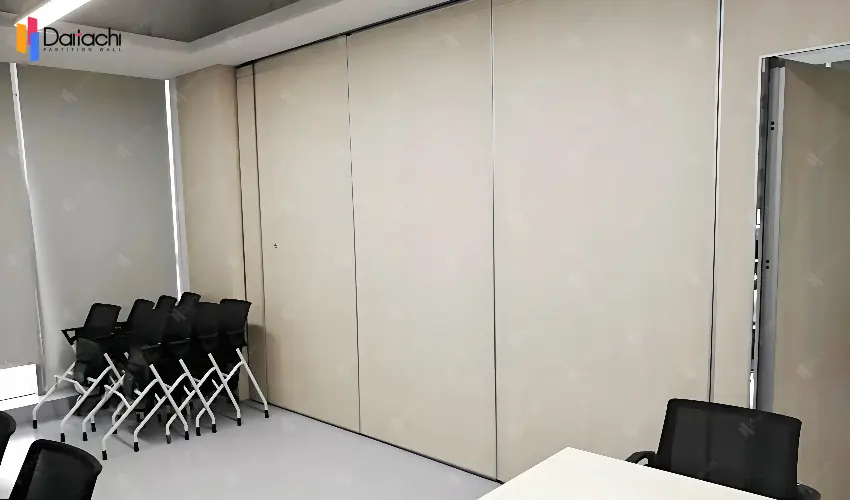
Veneer price range: 38-200 yuan/sheet.
The factors that affect the price of veneer are: Type of veneer Nature-based veneer (such as oak and walnut) is more costly over engineered or engineered veneer. Material base: Veneer that has multiple layers of base material is more costly as compared to that of particleboard. Surface treatments: Specific treatment like UV high gloss or matte finishes can increase the cost.
MDF cost range is 12-235 yuan/sheet.
Factors that influence the price Influencing factors: Density grade: The high-density fiberboard (HDF) is more costly than medium density fiberboard (MDF). Environmental grade: E0. MDF is much more costly than the E1 grade. Thickness is greater. Thicker MDF costs more.
Similar to the specifications of MDF. The veneers are generally costlier as compared to MDF and, in particular, natural the veneer.
With a tight budget: In cases where moisture resistance and durability are important then choose a veneer that has a multiple layers of base material. If a cost-effective style is required, select MDF grade E1. If you want to go for high-end requirements Natural textures are best select natural veneer. If you want intricate designs, select fiberboard of high density with a painted surface.
Tips: To avoid use caution when using MDF for humid areas such as bathrooms and kitchens. Pick ENF or F4-star eco-friendly grades. When it comes to veneers, be sure to check the surface smoothness of the joints. Avoid products with weak bonding strengths.
Related Articles: Veneer Treatments and Their Effects
Discover the Secrets of Movable Partition Wall Veneers: A Complete Analysis of Their Pros and Cons
Related Product: Type 100 Series Manual Sliding Partition Wall