To learn about all aspects related to Vertical Folding Partition Wall, you can consult our comprehensive guide on Vertical Folding Partition Wall Hub.
In today's era of increasingly prevalent "dual carbon" goals and green building concepts, building energy conservation is no longer just a technical issue, but a core topic in space design and operational strategies. As an efficient solution for flexible space partitioning, Baker retractable folding walls, with their unique variability and intelligent control capabilities, significantly contribute to reducing building energy consumption while enabling space reuse. The following are specific examples of its energy-saving mechanisms:
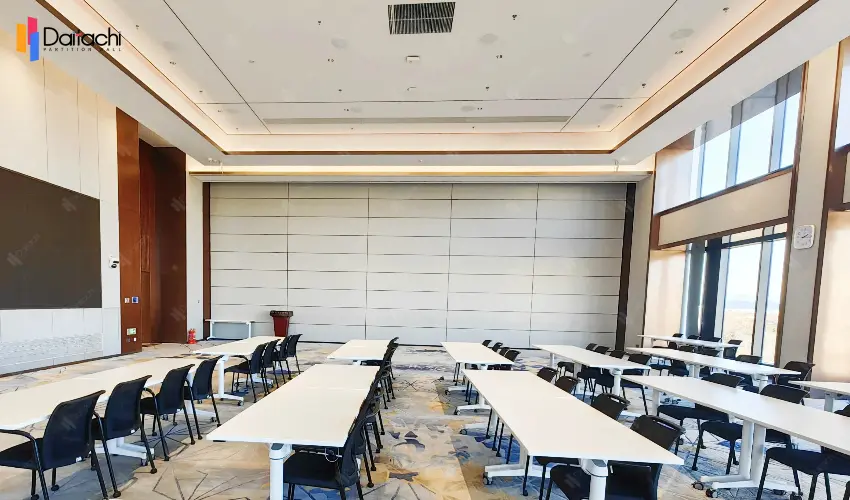
Large open spaces (such as banquet halls, conference centers, and multi-functional exhibition halls) will cause significant energy waste if the HVAC system is operated continuously for the entire space. Vertical lift walls can dynamically divide large spaces into multiple independent smaller areas, allowing air conditioning or heating to be activated only in the areas currently in use. This reduces the temperature control load on unused spaces, lowering the operating time and energy consumption of heating and cooling equipment, with measured energy savings of 20%–40%. For example, in a 1000㎡ banquet hall, when only 300㎡ is used for a small event, after raising the partition walls, the air conditioning system only needs to serve the 300㎡ area, and the remaining space can enter a "standby insulation" state.
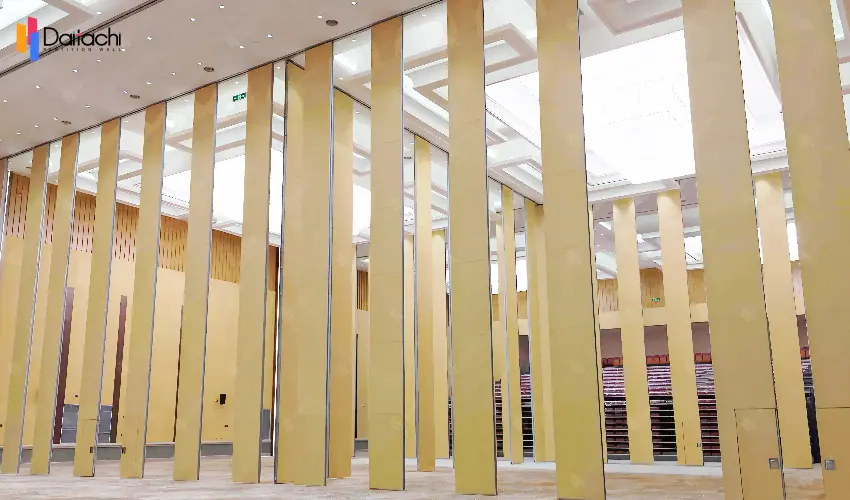
Traditional fixed partitions are difficult to adjust once built, while open spaces easily lead to mixing, short-circuiting, or leakage of hot and cold air. Vertical lift walls, however, utilize a high-seal structure design (with top, bottom, and side sealing strips), forming a nearly enclosed physical barrier when lowered. This effectively prevents air convection between different temperature zones, reducing the diffusion of cold/heat to unused areas, and simultaneously improving the efficiency of the HVAC system, avoiding "overkill" in energy use.
Space reuse is not limited to temperature control. When vertical lift walls are activated, they can be linked to intelligent lighting systems, only activating the lights and power outlets in the occupied areas, avoiding the inefficient "all-on, all-off" power consumption mode.
Combined with motion sensors or scheduled control systems, this further reduces lighting and standby energy consumption.
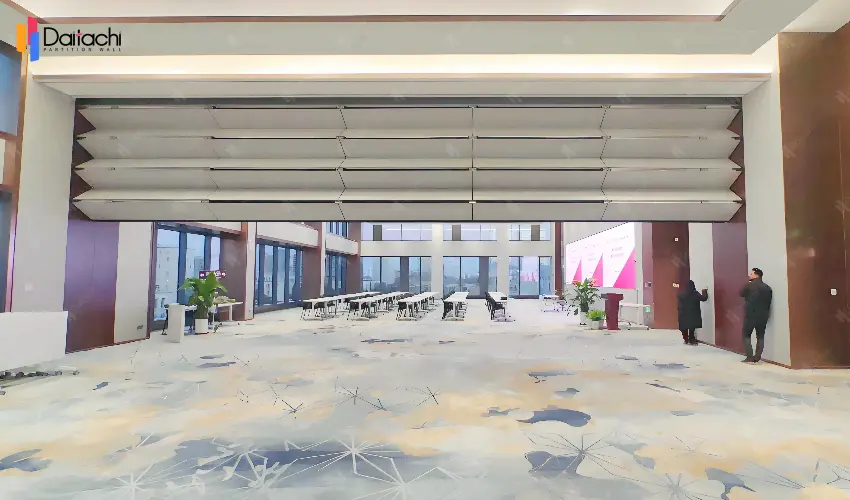
Through vertical lifting walls, "one room can serve multiple purposes" (e.g., a training classroom during the day and an event venue at night), resulting in higher output per unit area and reducing the need to construct new buildings for additional functions. From a whole-life cycle perspective, avoiding the significant embodied carbon emissions associated with the production of building materials, construction, and subsequent maintenance of new buildings is a deeper energy-saving and sustainable strategy.
Vertical lifting walls are not only enablers of spatial flexibility but also active control units in building energy efficiency systems. They make it possible to "use only what is needed, when it is needed," transforming passive energy saving into active management. In projects pursuing high-energy-efficiency buildings (such as LEED and Green Star certifications), such variable partition systems are becoming an indispensable green technology option.
Baker's vertical lifting wall system utilizes high-density composite panels and a professional sealing structure. The glass-free design ensures both safety and thermal insulation, and supports intelligent integration, helping you easily achieve the dual goals of space reuse and low-carbon operation.
Related Articles: Vertical Folding Lift-Up Walls: The Ideal Choice for Future Spaces
How Can Vertical Lifting and Folding Walls Be Used to Solve Problems in Public Spaces?