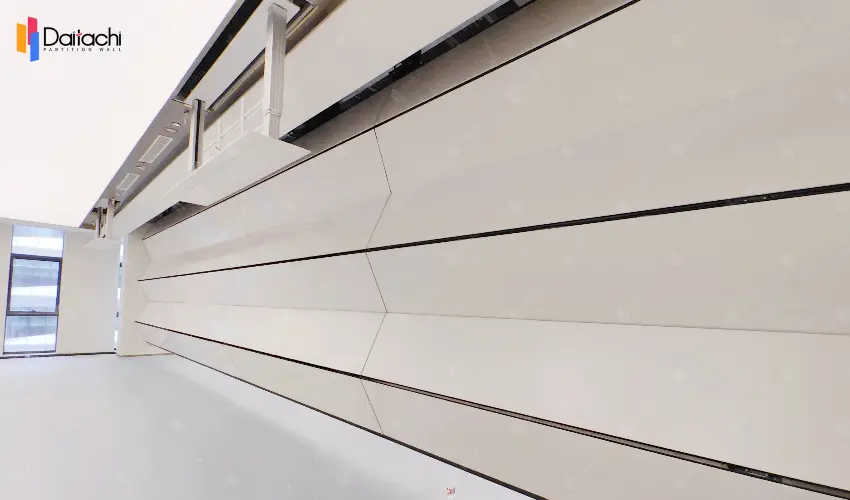
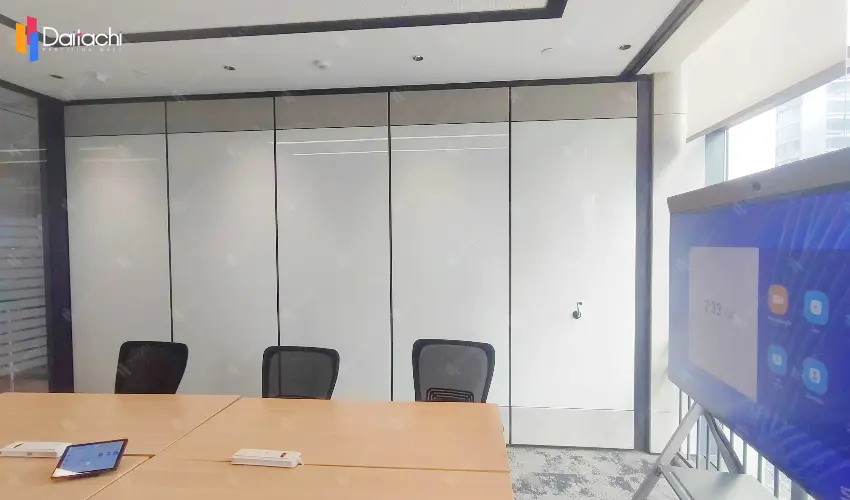
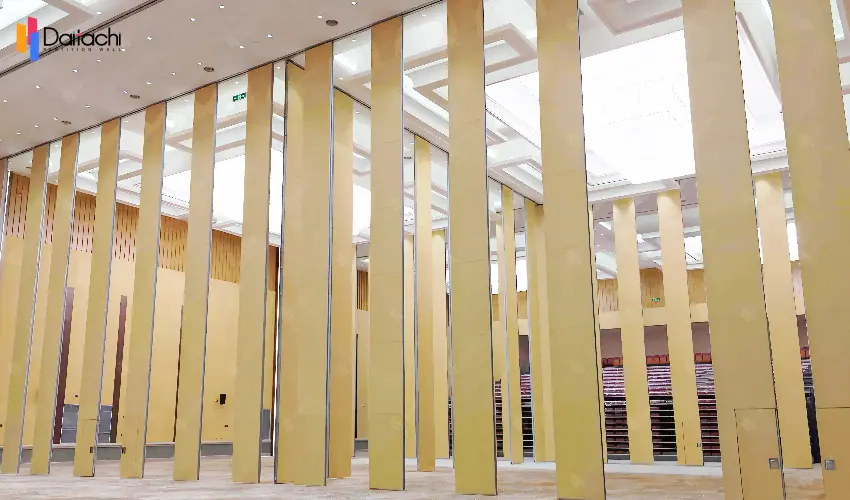
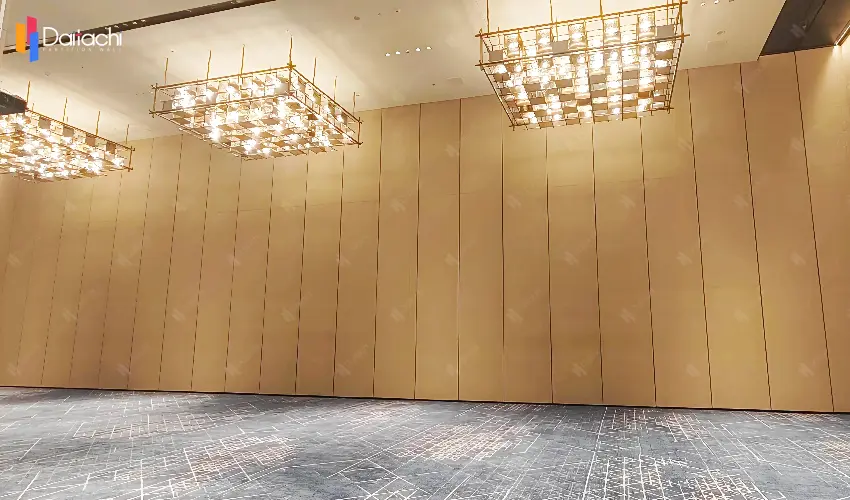
To learn about all aspects related to Vertical Folding Partition Wall, you can consult our comprehensive guide on Vertical Folding Partition Wall Hub.
As core equipment for dynamic space division, vertical lifting walls incorporate comprehensive, multi-layered safety measures across mechanical structure, electrical control, operating environment, and user operation to ensure the highest levels of protection for personnel, equipment, and facilities.
Fall Prevention System: Dual redundant braking combines a normally-closed electromagnetic brake (power-off locking) with a mechanical anti-fall device. In the event of power loss or motor failure, the electromagnetic brake locks the transmission shaft instantly, while the ratchet-style mechanical lock grips the track to prevent any accidental descent. The system is designed with a safety factor exceeding 3 times the wall’s weight and has been validated through 100,000 fatigue tests.
Anti-Sway Guidance: High-precision C-shaped or U-shaped guide rails paired with wear-resistant nylon guide shoes maintain vertical deviation within ±2mm, ensuring smooth, stable movement without jamming or tilting.
Overload Protection: A torque limiter on the transmission shaft disengages power transmission and triggers an alarm when abnormal resistance is detected. Bottom-mounted pressure sensors monitor contact force in real time; upon detecting obstacles, the system stops immediately and reverses for 3 seconds.
Emergency Stop & Limit Control: Distributed emergency stop buttons are located on the control panel, both sides of the wall, and remote stations. Photoelectric limit switches at top and bottom positions enable automatic slowdown and precise stopping to prevent over-travel.
Power Protection: Overvoltage/undervoltage monitoring automatically shuts down the system and issues alarms when voltage fluctuates beyond ±10%.
Fire & Flame Retardancy: H-class flame-retardant materials are used for motors and control boxes, with low-smoke, low-halogen cables meeting national safety standards.
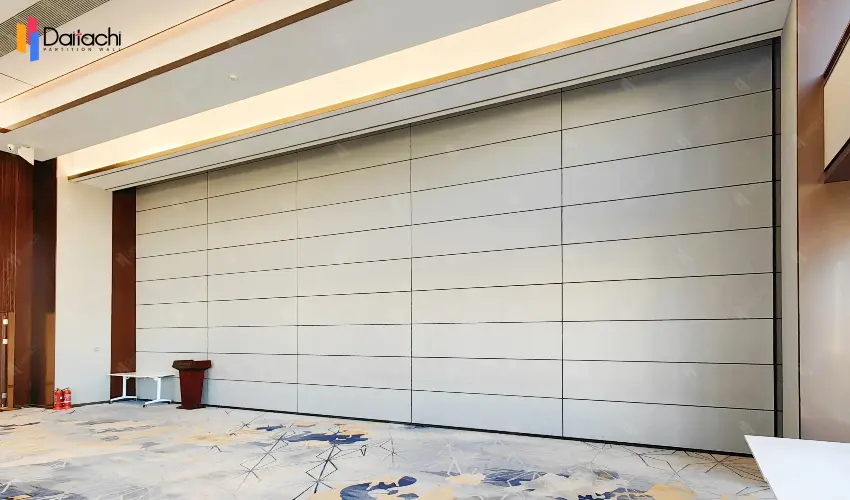
Collision & Obstacle Avoidance: Infrared sensors at the bottom and sides detect obstacles in real time, triggering an immediate stop. Soft start/stop via frequency converters ensures smooth acceleration ≤ 0.5 m/s², minimizing inertial impact.
Environmental Resilience: Rubber seals protect against dust and water ingress. In low-temperature conditions, automatic motor preheating maintains lubricant fluidity. Coastal or humid environments receive galvanization, specialized coatings, and anti-corrosion treatments for long-term reliability.
Clear operation manuals, instructional videos, and multi-language support are provided.
Prominent warning signs (“Do Not Climb,” “Keep Clear During Operation”) are displayed in accordance with national standards.
Quarterly maintenance schedules cover brake performance, track lubrication, and sensor calibration.
Power Outage: Electromagnetic and mechanical brakes activate simultaneously, holding the wall securely in position.
Chain Breakage: The anti-fall ratchet locks instantly, limiting descent to ≤50mm and triggering an alarm.
Personnel Intrusion: Infrared sensors detect obstacles, stopping the wall within 100mm and reversing to prevent injury.
Through this robust, multi-level safety architecture, vertical lifting walls deliver “zero-fault, zero-risk, zero-burden” performance, providing trusted reliability for modern commercial, public, and industrial environments.
Related Article: Why Can Vertical Lift Walls Operate so Smoothly?
Quality and Safety Specifications for Vertical Lifting Wall Systems