To learn about all aspects related to Vertical Folding Partition Wall, you can consult our comprehensive guide on Vertical Folding Partition Wall Hub.
RW62 is a single-number rating for weighted sound reduction index, defined within international standards to quantify the ability of building components to isolate airborne sound. The higher the numerical value, the more effective the sound insulation. Specifically:
High-frequency noise (e.g., human speech, traffic noise): An RW62 rating signifies that the component can effectively block sounds in frequency bands above 1000 Hz, achieving a sound reduction of approximately 62 dB. For instance, after passing through an RW62-rated wall, the sound pressure level of normal conversation can be reduced to near background noise levels, achieving an effect where speech becomes "unintelligible."
Low-frequency noise (e.g., aircraft roar, heavy machinery): Low-frequency sound waves possess strong penetrative power; for the 125 Hz frequency band, the sound reduction provided by an RW62-rated structure typically ranges from 38 to 40 dB. Although this performance is lower than that for high frequencies, it still significantly reduces the disruptive intensity of low-frequency noise.
Cinema-grade sound insulation requirements: Cinemas require the isolation of external noise while preventing internal sound from leaking out. RW62-rated walls ensure that the audience remains undisturbed by external factors during screenings, while simultaneously preventing light or noise pollution from affecting adjacent spaces.
Comparison with standard building norms: Standard residential walls typically offer a sound reduction of approximately RW45–50. In contrast, RW62 represents a high-end sound insulation class, commonly found in environments with stringent acoustic requirements—such as recording studios, theaters, and luxury hotels.
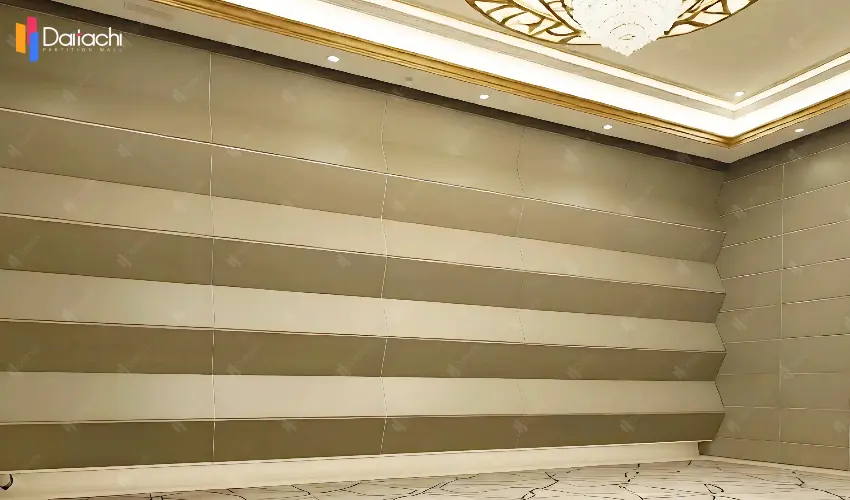
Through a combination of modular design, composite structures, and advanced sealing technologies, vertical lift walls enable flexible space partitioning while simultaneously meeting the RW62 sound insulation requirements. The core mechanisms for achieving this are as follows:
1. Multi-layer Composite Structure: Blocking the sound wave propagation path.
Typical Construction:
Outer Layer: High-density board material, providing the foundational surface density.
Middle Layer: Sound-absorbing material, absorbing sound wave energy and reducing resonance.
Inner Layer: Low-density board material or a damping layer, further attenuating the transmission of vibrations.
2. High-Precision Sealing System: Eliminating the Risk of Sound Leakage
Sealing Technology: When the wall is closed, rubber sealing strips are embedded at the interface between the bottom edge and the floor, while the joint at the top—where it meets the ceiling—employs an airtight design to ensure a seamless, gap-free closure.
Magnetic Sealing Strips: Certain high-end products incorporate multiple layers of magnetic sealing strips to further reduce sound transmission through any residual gaps.
3. Structural Optimization: Minimizing Sound Bridges and Resonance
Sound Bridge Disruption: Staggered stud or double-stud framing structures are utilized to prevent the direct transmission of vibrations caused by rigid structural connections.
Resonance Frequency Control: Board thicknesses are carefully adjusted to prevent the superposition of resonance frequencies, thereby preventing a sudden drop in sound insulation performance within specific frequency bands.
4. Material Innovation: Enhancing Low-Frequency Sound Insulation Performance
High-Density Rock Wool Panels: Featuring high density and substantial thickness, these rock wool panels achieve a sound insulation rating of 38 dB at 125 Hz (low frequency), outperforming traditional materials.
Damping Coatings: Applying a damping layer to the surface of the panels can reduce structural vibrations by 30% to 50%, significantly enhancing low-frequency sound insulation effectiveness.
Achieving an acoustic performance rating of RW62 signifies that the wall can effectively block mid-to-high-frequency noise while significantly reducing the intensity of low-frequency noise interference—thereby meeting the rigorous sound insulation standards required by cinemas. Through a combination of multi-layer composite structures, high-precision sealing systems, structural optimization, and material innovation, the vertical lift wall system achieves the RW62 sound insulation standard while enabling flexible space division, making it an ideal solution for high-end acoustic environments such as cinemas and theaters.
Related Articles: Vertical Lift Walls: Redefining Acoustic Standards with Precision
Vertical-Lift Folding Walls: A Detailed Analysis of High-Level STC/RW Standards